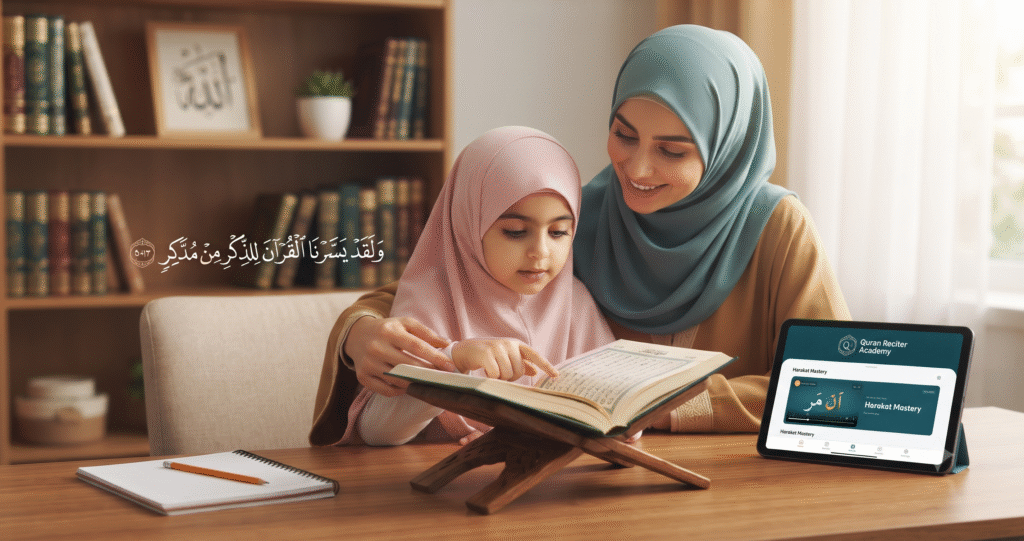
It is 8:30 PM on a school night, and your child is hunched over their Mushaf, struggling to sound out a single verse. You watch them stumble over basic vowels, feeling the weight of their long school day and the pressure to ensure they don’t lose their connection to the Quran. As a parent in the West, you know that how mastering Harakat speeds up your Quran reading is the secret key to unlocking their confidence, yet you aren’t sure how to bridge that gap. In this post, we will explore the mechanics of short vowels and how they transform halting reading into a fluid, spiritual experience. For those navigating this journey, Quran Reciter Academy serves as a trusted resource to provide your child with the expert guidance they need to succeed.
The Spiritual Weight of Every Vowel
The commitment to teaching your child the Quran is a profound act of love and responsibility. In our daily lives, we often rush through tasks, but the recitation of the Quran demands our full presence and precision.
“And We have certainly made the Qur’an easy for remembrance, so is there any who will remember?” (Surah Al-Qamar, 54:17)
Wa laqad yassarnal-qur’aana lidh-dhikri fahal min muddakir.
Tafsir: Allah emphasizes that He has simplified the Quran for those who seek to learn, understand, and remember it. This verse serves as a comforting reminder that the path to Quranic literacy is accessible when approached with sincerity.
For parents raising children in the West, this teaching offers profound reassurance. When you prioritize the correct articulation of Harakat (short vowels), you are not just teaching a language; you are fulfilling a divine mandate to preserve the Quranic message in your household. It turns a study session into a sacred ritual, grounding your child in their identity. By helping them move past technical hurdles, you allow the light of the Quran to reach their hearts more clearly.
Understanding how mastering Harakat speeds up your Quran reading
The term Harakat refers to the three basic vowel signs: Fatha, Kasra, and Damma. These markers act as the engine of Arabic text. When a child fails to distinguish between these sounds, their reading remains choppy because their brain is constantly pausing to decode the symbols.
When you focus on improving Quran reading fluency by mastering these vowels, you essentially automate the decoding process. Just as a child learns to recognize whole words in English to improve reading speed, recognizing the relationship between the letter and its Harakah allows the eye to glide across the page without hesitation.
Comparison of Reading Approaches
| Method | Focus | Speed Potential | Accuracy Risk |
| Guessing Vowels | Context/Memory | Very Low | High |
| Letter-by-Letter | Phonetic Analysis | Moderate | Low |
| Harakat Recognition | Pattern Recognition | Very High | Negligible |
| Audio Mimicry | Listening | High | Moderate |
| Qualified Tutoring | Correction/Drill | Highest | None |
Why Harakat are the foundation of Tajweed excellence
Many parents assume that Tajweed (the rules of recitation) is only for advanced students, but it actually begins with the very first vowel. The benefits of proper Tajweed for kids go far beyond just sounding “correct.” Precise vowel pronunciation is the difference between a child who is merely reading text and one who is truly reciting the word of Allah.
Studies in early childhood education show that children who master foundational phonics in their native language are better prepared to handle complex phonetic structures in secondary languages. Similarly, experts in online Islamic education observe that students who solidify their vowel sounds in the first few months progress to reading full Surahs three times faster than those who skip this step. According to a 2024 educational review on digital learning, interactive feedback from a qualified teacher is the single most important factor in sustaining a child’s progress in reading fluency.
Simple steps to boost your child’s recitation speed
You can implement these strategies at home to help your child gain momentum in their reading journey.
- The Vowel Drill: Dedicate the first five minutes of every session to reciting only the vowels (Fatha, Kasra, Damma) on a single line of the Quran.
- Highlight and Identify: Use a sticky note to cover the text and uncover one word at a time, asking your child to identify the vowel sound before they vocalize the letter.
- The Mirror Check: Have your child practice vowel shapes in front of a mirror to ensure their lips are rounded for Damma and their jaw is dropped for Kasra.
- Listen and Repeat: Play a short audio clip of a professional reciter and have your child shadow their speed, focusing specifically on how they treat the short vowels.
Practical tips for parents managing Quran studies
As a parent, your role is to provide consistency, not necessarily to be the expert instructor. Creating an environment that rewards effort rather than just perfection is vital.
- Always praise your child for identifying a vowel sound correctly, even if the letter articulation itself needs more practice.
- Keep your practice sessions limited to 15 or 20 minutes to prevent the frustration that comes with mental fatigue.
- Ensure that your child is sitting in a comfortable, quiet space that is free from the distractions of digital devices or household noise.
- Use a pointer or your finger to follow along with their reading to help them maintain focus on the specific word they are pronouncing.
- Ask your child to explain to you what the vowel sign is, as teaching it back to you reinforces their own memory.
- Celebrate the completion of every page or Surah to maintain high levels of motivation and excitement for their progress.
Important: Quick tip for parents: Do not be afraid to slow down when a mistake happens. It is much harder to correct a deeply ingrained bad habit later than it is to pause and repeat a word correctly the first time it is mispronounced.
Success through consistency: A real-world example
Consider the experience of 10-year-old Yusuf, who was constantly frustrated because he felt “stuck” on the first Juz. His mother decided to pivot away from trying to finish pages and instead spent two weeks doing nothing but mastering the Harakat patterns in their daily sessions. By the end of the month, Yusuf was reading with such unexpected fluidity that he finished his next five pages in the time it used to take him to finish one. This transformation gave him the confidence to enjoy his Quran time rather than dreading it.
Frequently Asked Questions
H3: How do I know if my child is struggling with Harakat?
You will notice them pausing for long periods at every letter or guessing the word based on its shape rather than its pronunciation. If they consistently confuse “a”, “i”, and “u” sounds, they need to revisit the vowel basics.
H3: Can online classes really help with correcting Tajweed?
Yes, modern platforms use clear audio and visual tools that allow tutors to correct even the most subtle vowel mistakes in real-time. Quran Reciter Academy provides this level of personalized attention to ensure your child develops perfect habits from the very beginning.
H3: What is the biggest mistake parents make in Quran teaching?
The biggest mistake is prioritizing quantity over quality, such as pushing a child to finish a page when they cannot yet read a line correctly. Slowing down to master the fundamentals will always result in faster overall progress.
H3: How can I help my child if I don’t speak Arabic?
You do not need to be fluent to be an effective partner in their learning. Your primary job is to facilitate consistent practice time and ensure they have access to a qualified, patient teacher who can guide them.
H3: How does mastering Harakat speed up your Quran reading specifically?
It reduces the cognitive load on your child’s brain, allowing them to process the text as a stream of sounds rather than a series of disconnected obstacles. Once the vowels become second nature, their reading speed increases naturally.
Conclusion and Call to Action
To wrap up, remember that the journey to Quranic fluency is built upon the small, consistent steps of mastering vowels, practicing with patience, and maintaining a positive environment at home. By prioritizing these fundamentals, you are giving your child the tools to connect deeply with the words of Allah for their entire life. This investment of time today will yield spiritual fruits that last far beyond their childhood years.
If you are ready to see your child gain confidence and speed in their recitation, we invite you to book a free trial Quran class at Quran Reciter Academy today. Our certified tutors understand the unique needs of children in the West and are ready to partner with you in this noble journey. May Allah make it easy for you and your family.