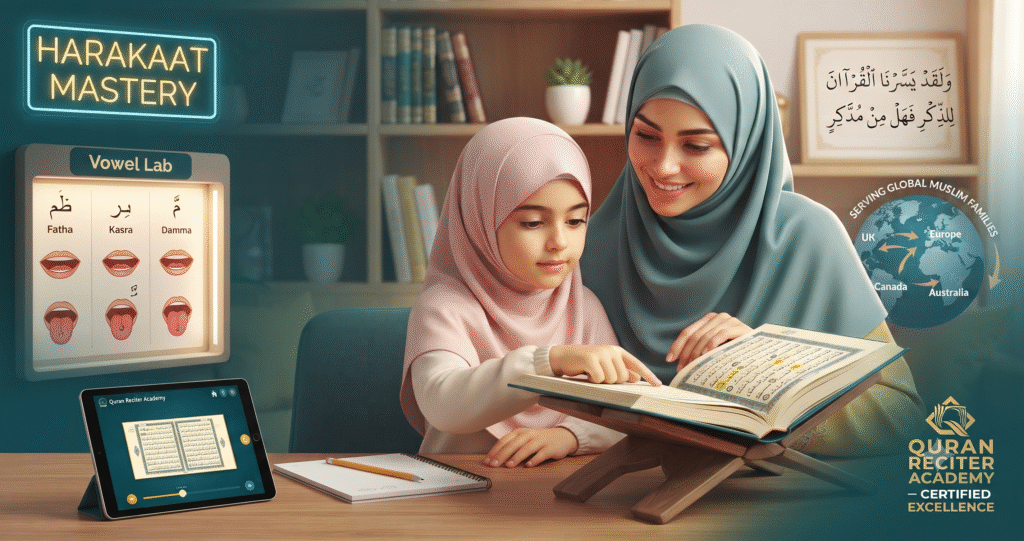
It’s 9:00 PM on a Tuesday. The school bag is packed, the lunchbox is ready, and your child is exhausted after a long day of navigating a Western school system. As you tuck them into bed, a quiet worry settles in: amidst their busy schedule, is their connection to the Quran truly deepening? You want them to recite with confidence and beauty, but often, the foundation—the 3 golden rules for perfect pronunciation of Arabic short vowels—seems to get lost in the shuffle of homework and extracurriculars.
If your child struggles with Harakaat (short vowels), they aren’t just mispronouncing letters; they are missing the rhythmic pulse of the Quran. In this guide, we will break down the essential techniques to master these sounds, ensuring your child’s recitation is both accurate and spiritually resonant. For those seeking expert guidance, Quran Reciter Academy offers specialized tutors who make mastering these foundational elements a joy for children.
The Divine Significance of Correct Recitation
As parents, we are tasked with the sacred duty of passing down the Book of Allah to the next generation. Our children’s recitation is not merely an academic skill; it is a direct conversation with the Creator.
“The one who is proficient in the recitation of the Qur’an will be with the honorable and obedient scribes (angels).” (Sahih Bukhari 4937)
Al-mahir bil-qur’ani ma’as-safaratil-kiramil-bararah.
Teaching your child to recite correctly is a profound act of worship. In a Western environment, where Arabic is rarely heard, providing your child with the tools to recite with Tajweed (proper pronunciation) creates an anchor for their identity. When they understand that even a short vowel—a Fatha, Damma, or Kasra—must be given its due right, they learn a lesson in precision, mindfulness, and respect for the Divine word. This is the cornerstone of their Islamic upbringing, helping them find beauty and belonging in the Quranic tradition regardless of where they live.
Mastering the Three Short Vowels (Harakaat)
To achieve perfect Arabic pronunciation for kids, one must first understand that Harakaat are not just marks; they are the heartbeats of the language. A Fatha (an ‘a’ sound above a letter) requires a distinct opening of the mouth. A Kasra (an ‘i’ sound below) demands a slight drop of the lower jaw, while a Damma (a ‘u’ sound above) requires the rounding of the lips.
Many parents wonder why their children struggle with these basics after months of study. Often, it is due to applying English phonetic habits to Arabic sounds. By focusing on the physical mechanics of the mouth rather than just the visual symbol, your child can move from “guessing” the sound to producing it with authority.
Comparing Traditional vs. Modern Learning Methods
| Feature | Traditional Rote Learning | Interactive Online Tutoring | Modern Multimedia Apps |
| Feedback Loop | Delayed/Absent | Instant Correction | Limited/None |
| Engagement | Low | High | Medium |
| Tajweed Precision | Varies | Certified Expert Oversight | Variable |
| Personalization | None | Tailored to Child’s Pace | One-size-fits-all |
| Comfort | Classroom-based | Home-based (Comfort) | Independent use |
Why Timing and Duration Matter in Recitation
A common mistake in learning Arabic short vowels is shortening or lengthening them incorrectly. A short vowel should be held for a very specific, brief duration—no more, no less. If your child stretches a Fatha, they accidentally create a Madd (long vowel), which can actually change the meaning of the word.
Research in early childhood linguistics indicates that children are highly sensitive to mimicry before the age of 12. According to studies in language acquisition, auditory feedback during this developmental window is critical for building long-term phonetic memory. When a child learns the 3 golden rules for perfect pronunciation of Arabic short vowels through consistent listening and expert feedback, they form a “muscle memory” for the Quran that lasts a lifetime.
Practical Steps to Improve Your Child’s Recitation
If you are ready to see progress, follow this structured approach at home to reinforce what your child learns with their tutor:
- The Mirror Exercise: Place a small mirror in front of your child while they recite. Ask them to watch their mouth shape for Damma to ensure their lips are fully rounded like a circle.
- Slow and Steady: Encourage them to recite at half their usual speed. Focusing on one letter at a time prevents them from rushing through the short vowels.
- Auditory Contrast: Play a professional Qari’s recording and ask your child to identify when the reciter emphasizes a Kasra. This trains their ear to hear the nuance before they try to replicate it.
- Consistency Over Duration: Practice for 10 minutes every day rather than one hour once a week. Frequent, short bursts of focused effort are scientifically proven to enhance retention in primary-aged children.
How to Avoid Common Pronunciation Pitfalls
Even with the best intentions, some bad habits can stick. Correcting Quran recitation mistakes starts with identifying common traps. For example, many children carry their native English vowel sounds into their Arabic. They might pronounce a Fatha as a “uh” sound instead of a sharp, clear “a.”
Important: Quick tip for parents: Always record your child’s recitation once a week. When they listen back to themselves, they often notice their own mistakes before you even point them out, which builds their self-correction skills.
- Ensure they do not “slide” between letters, as each letter must have a distinct sound.
- Check that the Damma does not turn into an English “o” sound.
- Verify that their jaw drops enough for the Kasra to sound crisp.
- Make sure they are not holding the short vowels for too long, which creates incorrect elongations.
- Encourage them to take a full breath before starting a line to ensure they don’t rush the end.
- Remind them that the Quran is a physical act, so their tongue and lips must be active, not lazy.
Building a Culture of Quranic Excellence at Home
A small story: Amina, a 7-year-old living in Toronto, struggled with her Tajweed for months. Her mother began using a “Quran corner” where they would sit for 15 minutes each day to practice just one line, focusing intently on the short vowel accuracy. Within a few weeks, Amina stopped viewing the session as a chore and started seeing it as a rewarding challenge. The result wasn’t just better pronunciation; it was a newfound confidence that translated into her schoolwork and general demeanor.
Frequently Asked Questions
H3: How long does it take for a child to master Arabic vowels?
Mastery depends on the child’s age and frequency of practice, but with consistent daily engagement, most children see significant improvement in 3 to 6 months. Using a structured curriculum helps bridge gaps faster. Quran Reciter Academy provides personalized pathways that help children achieve these milestones efficiently.
H3: My child finds Arabic hard, how do I keep them motivated?
Focus on the why rather than just the mechanics. Share stories of the Sahaba, emphasize the reward of every letter, and celebrate small wins. Keeping sessions short and positive prevents burnout and maintains their love for the process.
H3: Are online classes as effective as in-person for Tajweed?
Modern online platforms now use high-definition video and dedicated screen-sharing tools that allow tutors to monitor lip movement and tongue position with incredible precision. This makes online learning highly effective for students in the West.
H3: Should I teach my child to read Arabic before Tajweed?
It is best to integrate them simultaneously. Learning the mechanics of the 3 golden rules for perfect pronunciation of Arabic short vowels while learning the alphabet ensures they don’t develop “accented” habits that become difficult to break later.
H3: How can I help if I don’t know Tajweed myself?
You don’t need to be a scholar to be a supportive parent. Your role is to provide the environment, the time, and access to qualified teachers. You can learn alongside them, which is a beautiful way to bond.
Final Thoughts on Your Child’s Quranic Journey
To wrap up, remember these three keys to success: Consistency is more important than duration, Active Listening to expert recitations is essential, and Positive Reinforcement keeps the heart attached to the Quran. Your commitment to your child’s education today is an investment in their character and their spiritual future.
When you provide them with the right resources, you are giving them the keys to unlock the beauty of the Quranic text for the rest of their lives. If you are looking for a partner in this noble journey, Quran Reciter Academy is here to help. We invite you to book a free trial Quran class today to see how our certified tutors can transform your child’s recitation journey. May Allah make it easy for you and your family to raise children who love His Book