Online Quran Classes for Women Choose the Right Course
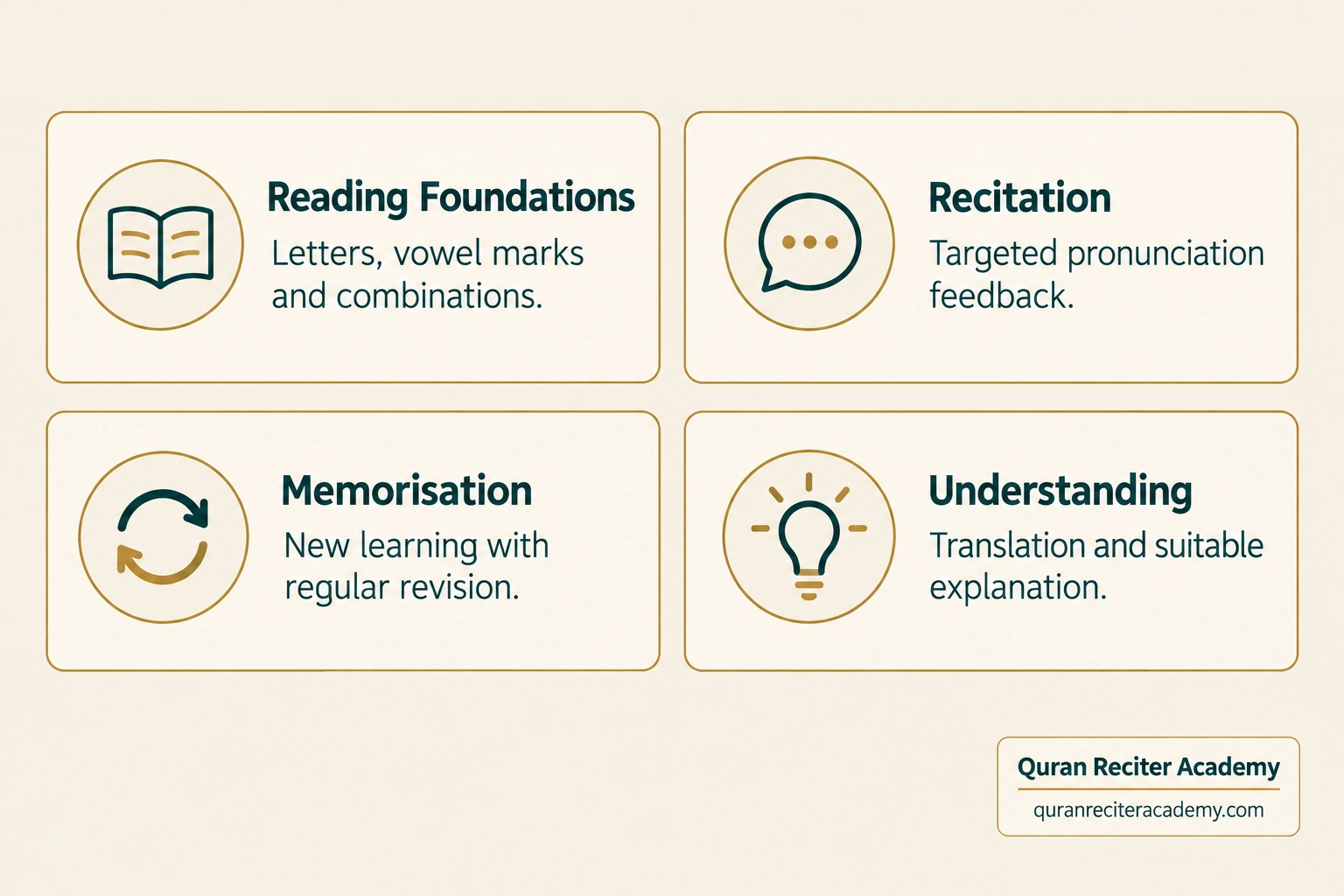
Online Quran classes for women should match your learning level, goal and preferred teaching arrangement. Start by deciding whether you need help with Arabic reading, recitation, Tajweed, memorisation or understanding. Then ask how the teacher will assess your starting point and give you individual feedback.
You may be beginning for the first time, returning after a long break or correcting mistakes in familiar recitation. Those situations need different lesson plans.
Before enrolling, check teacher experience, female teacher availability if that matters to you, class format, privacy and the practice expected between lessons.
Decide What You Want to Improve First
A course name gives you a starting point, but your current skills should determine the first lesson.
You might recognise Arabic letters yet struggle to join sounds. You may read comfortably but need help with pronunciation. Or you may have memorised passages without feeling confident about their accuracy.
Tell the teacher what you can do independently and what you find difficult.
| Your Main Need | A Suitable Learning Focus | What to Check in an Assessment |
|---|---|---|
| Starting with Arabic script | Letters, vowel marks and sound combinations | Where to begin and which foundations need practice |
| Reading with frequent hesitation | Guided Quran reading | Whether difficulty comes from recognition, joining sounds or pronunciation |
| Improving recitation | Tajweed applied to selected passages | Which correction should receive attention first |
| Beginning or returning to memorisation | Hifz with a revision plan | Recitation accuracy, existing retention and manageable new material |
| Understanding what you read | Translation and suitable explanation | Which texts are used and how questions are handled |
Tajweed concerns the rules governing correct Quran recitation. Hifz means memorisation. Reading, pronunciation, memorisation and understanding are related goals, but progress in one does not establish mastery of all four.
If pronunciation is your main concern, review the online Tajweed course information and ask how rules would be connected to your actual recitation.
If You Are Starting From the Beginning
Ask for an assessment that allows you to explain your experience without embarrassment. You do not need to prepare a polished recitation to enquire.
A beginner resource such as Noorani Qaida can introduce letters, vowel marks and combinations. Ask why a particular starting exercise fits your needs and how understanding will be checked before moving forward.
If You Are Returning After a Break
Tell the teacher what you previously studied and, if possible, bring the resource you used. An assessment can identify what you still remember and what needs revisiting.
Avoid choosing a course solely by the last page you completed. Being familiar with material and reading it independently may be different things.
What Should Online Quran Classes for Women Offer?
Look for a clear teaching arrangement, suitable feedback and respectful communication. Women’s classes should still distinguish learners by their skills and goals.
In Sahih al-Bukhari 101, women asked the Prophet ﷺ to allocate time for their learning, and he arranged a day to teach them. This paraphrases the opening of the report and illustrates women actively seeking religious instruction.
You can approach your own learning with specific questions about the support you need.
Clarify Female Teacher and Group Preferences
If you prefer a female Quran teacher, say so before booking. Ask about availability, teaching language, relevant recitation training and experience with learners at your level.
A female instructor and a women-only group are separate arrangements. Check who participates in the class and whether a substitute teacher might be involved.
The academy’s female Quran teacher information is a relevant place to begin those enquiries.
Compare Individual and Group Lessons
Individual lessons allow the teacher to focus on your recitation and questions. Ask how the lesson time will be used and what feedback you will receive.
Group classes may offer discussion and shared learning. Check whether participants have compatible starting levels, how much time each learner receives to recite and whether individual corrections are included.
A group lesson about a Tajweed rule and a personal recitation assessment serve different purposes. Ask whether the proposed arrangement provides the support your goal requires.
You can review the Quran classes for sisters information and ask which formats and starting levels are currently supported.
Use a First Lesson to Assess the Fit
An introductory lesson for online Quran classes for women should help you understand the teacher’s approach as well as your own starting point.
Explain your goal, then attempt suitable material without rehearsing it solely to appear more advanced. Let the teacher hear where you hesitate or need help.
Notice whether the teacher:
- Identifies a specific learning need.
- Demonstrates a correction clearly.
- Gives you time to attempt it again.
- Checks whether you can apply it with less prompting.
- Ends with an understandable practice task.
Ask what the first phase of learning would cover and how it would be reviewed. A fixed promise to finish a course quickly is less useful than an explanation of what you need to learn next.
Ask for Feedback You Can Use
“Practise more” leaves several questions unanswered. Ask which item to practise, what to listen for and how you will know whether you have improved.
For example, a teacher might identify a vowel-length error in a short passage and select a small exercise to address it. The instruction should explain the correct pattern and provide an accurate model.
If the explanation is unclear, ask for another demonstration. Being able to request clarification is part of finding a suitable teaching relationship.
Turn One Correction Into a Manageable Practice Task
Useful online Quran classes for women should connect lesson feedback to practice you can repeat accurately at home.
The following process is an illustrative teaching example. Your teacher should select the passage, explain the relevant rule and decide how much material is suitable.
A Worked Recitation-Practice Example
Purpose: apply one correction in a selected passage and check whether it carries over to another example.
- Identify the issue. The teacher listens and explains one recurring error.
- Compare the models. Listen to the teacher’s accurate demonstration and notice the feature that needs changing.
- Attempt the selected item. Recite slowly enough to apply the correction.
- Receive specific feedback. Ask whether the change was accurate and what still needs work.
- Try a suitable new example. The teacher checks whether you can apply the same guidance elsewhere.
- Return to it later. Review the item at another practice session and during a later lesson.
If the correction remains unclear, reduce the amount of text and ask for further modelling. Add more material when you can manage the current task with greater independence.
Recording an attempt can help you prepare a question, but agree on consent, submission and storage arrangements first. Listening to yourself also requires knowing what feature to check.
For Memorisation, Include Revision From the Start
Ask how new memorisation will be balanced with earlier passages. A plan should explain when older material is reviewed and what happens when retention becomes less dependable.
If pronunciation needs correcting, discuss that before repeatedly memorising the same passage. Ask the teacher to check both recall and recitation accuracy.
Avoid measuring progress only by the amount of new material. Maintaining earlier learning is part of the goal.
Build a Routine Around Your Real Week
Online Quran classes for women can fit different lives, but flexibility needs to be confirmed rather than assumed.
You may be balancing employment, study, care responsibilities, family commitments or several of these. Tell the provider which lesson times you can realistically maintain and how much practice time you have.
General learning guidance from the Institute of Education Sciences recommends spacing learning over time and revisiting earlier material. This supports planning repeated review; it does not establish a women-specific Quran timetable or guarantee a completion date.
An Illustrative Ten-Minute Review
| Suggested Time | Activity |
|---|---|
| 3 minutes | Review an earlier exercise or passage |
| 5 minutes | Practise the teacher’s current correction or assigned material |
| 2 minutes | Note one difficulty or question for the next lesson |
This is an adaptable example. Change the balance to suit your goal, particularly if memorisation requires more revision or a beginner exercise needs slower practice.
On a difficult day, ask the teacher which small task should take priority. If your circumstances change for longer, review the schedule instead of continually struggling to meet an unsuitable plan.
Check Time Zones and Missed-Lesson Terms
Confirm the time zone used in booking messages and whether seasonal clock changes affect your slot. Ask how absences, late cancellations, travel and teacher changes are handled.
Agree on these details before paying for a recurring arrangement.
Compare Fees and Privacy Alongside Teaching Quality
When comparing online Quran classes for women, look at the full arrangement behind the price.
Ask how many lessons are included, their duration, the class size and whether individual feedback is part of the fee. Check any enrolment charges, resource costs, renewal terms and refund conditions.
For a group course, clarify whether the price includes personal recitation checks or mainly shared instruction. For individual tuition, ask how progress and practice are communicated.
A lower monthly fee may involve a different amount or type of teaching. Compare like-for-like details before deciding.
Understand Recording and Access Arrangements
Ask whether lessons are recorded, who can join meetings and who can access recordings or submitted recitation files.
Check whether recording is required or optional, how long files are retained and how you can raise a privacy concern. In group classes, ask whether your name or contact information is visible to other learners.
You should understand these arrangements before sharing personal information or recorded work.
Check Progress Through Specific Changes
Ask the teacher to review what you can now do with less help.
Depending on your goal, that might include:
- Reading a new combination made from familiar letters and vowel marks.
- Applying a pronunciation correction in an unfamiliar example.
- Reciting an earlier passage after a gap.
- Explaining the meaning of material you have studied.
- Identifying a recurring error and knowing how to ask about it.
Keep a short record of the current goal, the difficulty being addressed and the next practice task. Revisit familiar material alongside new work.
If progress feels unclear, ask whether the starting level, class format or amount of practice needs changing. A useful review should produce an adjustment you understand.
Questions Women Often Ask
Do I Need to Speak Arabic Before Joining?
No. Learning to read Arabic script and learning conversational Arabic are different goals. Ask whether the teacher can explain lessons in a language you understand. If understanding Quranic meanings is also your aim, discuss how translation and suitable explanation will be included.
Must I Keep My Camera On?
Check the provider’s policy before booking. If audio-only participation is available, confirm that sound quality is adequate for recitation feedback. Some pronunciation guidance may benefit from visual demonstration, so ask how the teacher would handle that within your preferred arrangement.
Can Lessons Continue During Menstruation?
Lesson planning should follow the religious guidance you trust. Scholarly views differ on recitation and touching a physical mushaf, or copy of the Quran; Egypt’s Dar Al-Ifta describes majority and Maliki positions on these questions.
Ask a qualified scholar about your circumstances, then agree with the teacher how lessons can be adapted. Depending on that guidance, an adjusted session might involve listening, studying meanings or discussing lesson notes. Confirm adaptation and rescheduling options before enrolling.
Choose a Clear Next Step
Before choosing online Quran classes for women, write down your current level, main goal, preferred teacher arrangement and available times.
You can ask Quran Reciter Academy about a suitable women’s learning plan and enquire about assessment, teacher options, class format and fees.
A useful starting plan should explain what you will learn first, how corrections will be given and how progress will be reviewed. Choose an arrangement that gives you a clear task to practise and room to ask questions.