Quran Classes for Adults and Kids Choose the Right Learning Path
Quran classes for adults and kids should match each learner’s reading ability, pronunciation needs, and goals. An adult returning after a long break may need help correcting familiar mistakes, while a child may be meeting Arabic letters for the first time. Both need a clear starting point and useful feedback.
If several people in your family want to learn, assess them individually before choosing a shared schedule or course. Age helps shape the teaching approach, but it does not tell the teacher everything about reading level.
This guide helps you choose a suitable learning path, compare class arrangements, and build a routine that fits work, school, and home life.
Choose the Learning Goal Before the Course
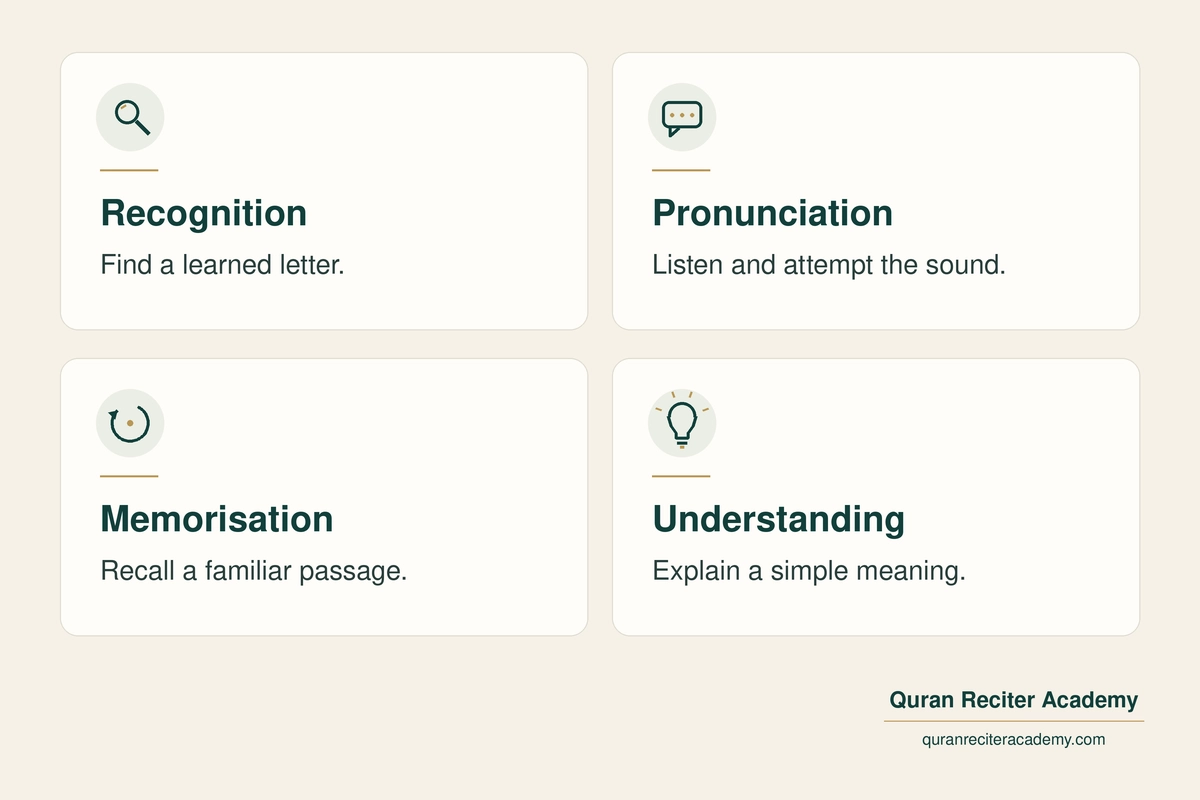
When comparing Quran classes for adults and kids, first decide what you want the lessons to develop. Reading, pronunciation, memorisation, and understanding are connected, but progress in one area does not automatically establish progress in another.
For example, a child may remember a short surah without being able to read it independently. An adult may read Arabic text steadily while needing correction on particular sounds.
Use these starting points to frame a conversation with the teacher:
| Current Situation | Possible Learning Path | What to Check First |
|---|---|---|
| Cannot recognise Arabic letters reliably | Beginner Qaida or another structured reading foundation | Letter recognition and sound production |
| Knows letters but struggles to combine them | Guided Quran reading | Vowel marks, joined forms, and reading combinations |
| Reads independently but makes recurring recitation errors | Targeted Tajweed instruction | Which errors occur and how they will be corrected |
| Wants to memorise passages | Memorisation with planned revision | Current recitation, retention, and realistic practice time |
| Wants to understand the text | Translation or introductory explanation | Teaching language, source material, and lesson scope |
A Qaida is a beginner reading book. Tajweed concerns the rules and articulation used in Quran recitation. Hifz refers to memorisation, while tafsir explains the Quran’s meanings and context.
Review the Quran course options with your starting point in mind. Ask the teacher to explain why a course suits you rather than choosing solely from its title.
How Should Quran Classes for Adults and Kids Differ?
The learning goal may be similar, but explanations, activities, and support should suit the person attending.
Adult Learners Need Respectful, Specific Instruction
If you are beginning as an adult, tell the teacher what you can currently attempt and where you feel uncertain. You do not need to pretend you understand a rule or hide a sound you find difficult.
For example:
“I recognise most letters, but I hesitate when they appear in joined words.”
Or:
“I learned some recitation years ago and want you to check my pronunciation.”
Ask for a manageable learning target and feedback you can use between lessons. Adults starting from the alphabet should receive clear, respectful instruction without being spoken to as though they are children.
When exploring online Quran classes for adults, check the teaching language, privacy arrangements, and how lessons can fit your work or caring responsibilities.
The value of learning the Quran is expressed in Sahih al-Bukhari 5027. In the English wording published by Sunnah.com, the Prophet ﷺ said:
“The best among you (Muslims) are those who learn the Qur’an and teach it.”
For someone beginning or returning, a useful first step is simply to identify what needs attention and agree how to practise it.
Children Need Activities Matched to Their Readiness
A child’s lesson should reflect their current understanding, language needs, and ability to participate. A younger beginner might begin by finding a familiar letter; an older child might work on reading a short selection independently.
The National Association for the Education of Young Children recommends adapting teaching to individual development, abilities, experiences, and interests. This provides general guidance for evaluating a young child’s learning environment. Read its teaching guidance.
Parents can ask what the teacher will do if the child becomes quiet, confused, or frustrated. Look for a specific response, such as simplifying an instruction, revisiting familiar material, or changing the activity.
When reviewing Quran classes for kids, check how parents receive updates and what support is expected at home.
Decide Whether Lessons Should Be Individual or Shared
Quran classes for adults and kids can be arranged through individual tuition or appropriately organised groups. The practical question is whether each learner receives enough suitable instruction and feedback.
Individual Lessons
Individual tuition allows the teacher to focus on one learner’s current needs. During a trial, check whether the tutor uses that time to observe reading, correct errors, and explain the next learning step.
This arrangement may suit an adult who wants privacy, a child who needs a different pace, or a learner working on particular pronunciation difficulties.
Group Lessons
A group may suit learners who have compatible starting levels and goals. Ask how the teacher checks each person’s reading and how much individual speaking time is available.
A shared class becomes less useful if one learner spends most of it waiting while another receives instruction at a different level.
Family Learning
Family members can encourage one another without following the same lesson.
Illustrative example: A parent can read independently and wants pronunciation feedback. Their child is still learning letters. They could practise at the same general time at home while receiving separate teaching tasks and assessments.
If you are considering joint tuition, ask how the teacher would manage those different needs. Sharing a family routine does not require identical learning goals.
Use a Trial to Check the Teaching Process
Before enrolling, ask for a short assessment suited to the learner’s current ability. A beginner might identify letters, while a returning reader might recite a familiar selection.
Look for three things:
- A clear starting point: The teacher explains what they observed.
- An understandable correction: The learner knows what to attempt differently.
- A manageable next task: Home practice follows directly from the lesson.
Here is a suggested pronunciation practice process:
- The teacher selects one sound or reading combination that needs attention.
- The learner listens to an accurate model.
- They attempt it with guidance, then try independently.
- The teacher identifies what improved and what still needs practice.
- The same skill is checked again in a suitable new example.
The purpose is to make correction usable. If the learner struggles, simplify the task or return to the model. Move forward when the teacher has checked understanding rather than relying only on repetition.
Clear audio matters. If the connection distorts a sound, resolve that before treating it as a learner’s error.
Build a Routine That Each Learner Can Maintain
A workable schedule for Quran classes for adults and kids includes tuition, practice, and revision. Agree how much work can reasonably fit between lessons.
Adults may need a routine around shifts, commuting, or childcare. Children may need a rested period around school, meals, and family activities.
Here is an illustrative home-practice plan, separate from the actual lesson timetable:
| Learner | Practice Task | Suggested Starting Time | Useful Check |
|---|---|---|---|
| Adult beginner | Revisit one teacher-selected reading combination | 5–10 minutes | Can it be read with fewer prompts? |
| Returning adult | Practise a correction using the agreed example | 5–10 minutes | Does it carry into another example? |
| Young beginner | Find and sound out a few learned letters | 3–5 minutes | Does recognition survive a change in position? |
| Memorisation learner | Review an earlier passage before new material | Agree with the teacher | What can be recalled after a gap? |
These timings are adaptable suggestions, not age-based attention limits or academy lesson terms.
For memorisation, ask how older material will be revisited. Adding new passages without checking retention gives an incomplete picture of progress.
If a week becomes difficult, tell the teacher what practice was manageable. Adjusting the workload provides a clearer plan than repeatedly assigning tasks that cannot be completed.
Compare Fees Alongside the Teaching Arrangement
When comparing the cost of Quran classes for adults and kids, ask what the monthly fee actually covers.
Check:
- Number and duration of lessons.
- Individual or group teaching.
- Required books or materials.
- Registration or assessment charges.
- Missed lessons and rescheduling.
- Cancellation notice and payment terms.
- Any family discount and its conditions.
Two plans with the same monthly price can provide different amounts of teaching time and different arrangements.
If you are booking for several family members, request a written breakdown for each learner. Confirm whether they can follow separate courses and timetables under the proposed arrangement.
Measure Progress Through Skills You Can Observe
Ask for updates that describe what the learner can do independently, what still needs prompting, and what requires revision.
Useful observations include:
- Recognising a learned letter in unfamiliar arrangements.
- Reading a taught combination without guessing.
- Applying a pronunciation correction in another example.
- Recalling an earlier memorised passage after a gap.
- Explaining a taught meaning in their own words.
Completing pages and attending lessons are useful records, but they do not replace checks of learning.
Agree when progress will be reviewed. If a task remains difficult, ask whether the explanation, materials, practice plan, or teaching pace needs adjustment.
Choose a Starting Point for Every Learner
Choosing Quran classes for adults and kids begins with a simple description of each learner: current ability, main goal, teaching language, and available practice time.
Quran Reciter Academy’s course overview lists adult learning alongside beginner reading, Tajweed, and memorisation options. Its trial page advertises a free introductory class without a credit card requirement. Confirm the current arrangements for each adult or child when enquiring.
Request a trial lesson and ask for a recommendation based on the learner’s assessment. If several family members want lessons, explain their different starting points before agreeing a schedule.
Frequently Asked Questions
Can I Request a Female Quran Teacher?
Ask whether a female teacher is available for your preferred course and time. Confirm the arrangement before enrolling, especially if maintaining the same tutor matters to you.
Can Lessons Be Taught in English or Urdu?
Ask which languages the assigned teacher can use comfortably. The language needed for explanations should be distinguished from the Arabic used in Quran reading and recitation.
Do I Need to Buy a Quran or Qaida Before the First Lesson?
Ask which edition or materials the teacher uses before buying anything. A provider may use digital or printed resources; confirm what is required for your starting level.
Can I Change Courses After Beginning?
Discuss the reason with the teacher and ask for a revised assessment. Confirm how changing courses affects the timetable, tutor, fees, and any existing enrolment terms.