Find the Right Fit for Your Goals
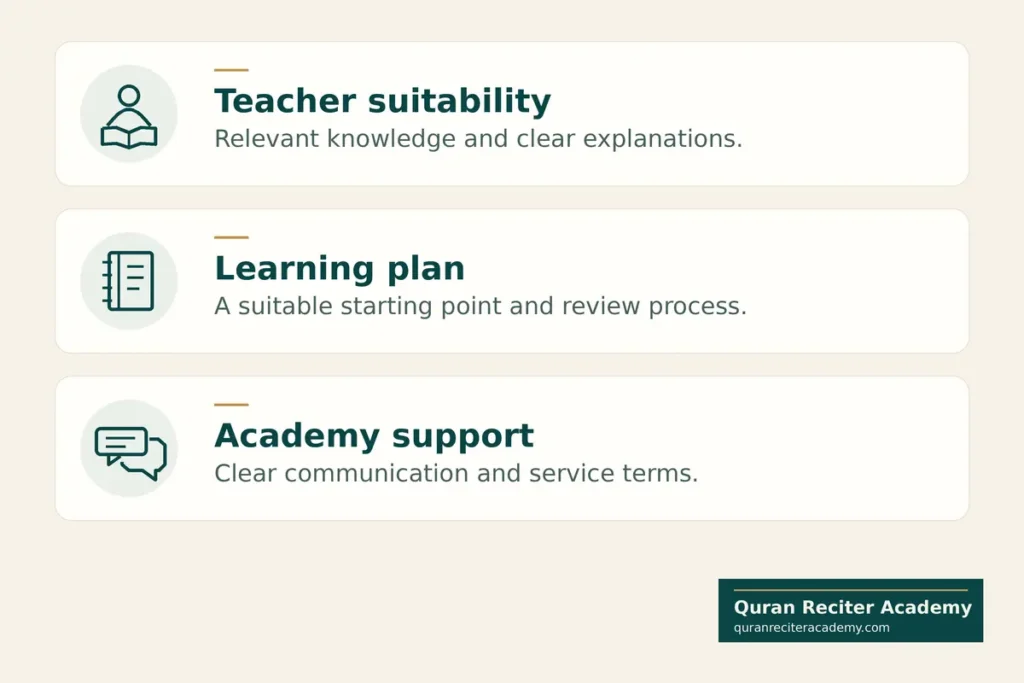
Choose a quran learning academy by checking three things: whether its teachers suit the learner, whether its courses have a clear learning plan and whether its support arrangements are explained before enrolment. A useful starting assessment should connect those three things to your actual needs.
For parents, that means understanding who will teach your child, what they will practise and how you will hear about progress. For adults, it means finding a suitable starting level, a respectful learning environment and a schedule you can maintain.
Begin with the learner’s situation. Then ask the academy to show how its teaching and organisation will support it.
What Should a Quran Learning Academy Offer?
An academy may bring together teachers, courses and administrative support. When comparing providers, establish which of these services are actually included in your package.
Ask who is responsible for:
- Assessing the learner’s starting level.
- Selecting suitable material and lesson objectives.
- Teaching and correcting recitation.
- Recording progress and assigning practice.
- Managing timetable changes and missed lessons.
- Responding when a learner or parent needs help.
These responsibilities may be handled by one person or several people. What matters is that you know whom to contact and that important learning information is preserved.
For example, if a teacher changes, will the replacement know which sounds the learner finds difficult and what they have already studied? A clear handover makes it easier to continue from the right point.
Academy or Independent Tutor?
An independent tutor may offer a direct relationship and a consistent personal approach. An academy may offer access to several teachers, course options or a separate support contact.
Neither arrangement guarantees good teaching. Ask about the services that matter to you rather than assuming that a larger organisation offers better lessons.
If you need one particular timetable, language or teacher preference, check that arrangement specifically. General statements about flexibility are less useful than confirmation of your available lesson slots.
Describe the Learner Before Choosing the Course
A course name is only helpful when it matches the learner’s current ability.
Prepare a short learning profile before your first enquiry:
- Current ability: what can the learner read or recite independently?
- Previous study: which material have they covered, and how recently?
- Main difficulty: where do they hesitate, guess or need repeated help?
- Immediate goal: what would useful improvement look like?
- Practical needs: which times, teaching language or support arrangements matter?
An adult might say: “I can read familiar short passages, but I hesitate with unfamiliar words and want help with pronunciation.”
A parent might say: “My daughter remembers several short surahs, but she is still learning to recognise written letters.”
These descriptions point to different needs. Memorising familiar passages, reading new text and understanding meaning are separate skills.
If the learner has studied elsewhere, share the previous book, recent lesson topic and any useful feedback. You do not need a formal certificate or a complete record to explain what has already been learned.
Ask How Teachers Are Matched to Students
A quran learning academy should explain how it chooses a teacher for your situation. Relevant knowledge matters, and so does the ability to communicate that knowledge at the learner’s level.
Ask about the proposed teacher’s study background, relevant qualifications and experience with the type of learner you are enrolling. Request a clear explanation of what any qualification covers.
A child learning letter sounds needs understandable demonstrations, patient correction and manageable activities. An adult correcting established reading habits may need detailed feedback and time to discuss recurring difficulties.
Questions worth asking include:
- Has this teacher taught learners at this starting level?
- Can the teacher explain lessons in a language the learner understands?
- How are repeated pronunciation mistakes handled?
- Can the learner ask questions during the lesson?
- How are teacher suitability concerns reviewed?
Explore the academy’s Quran teacher information when comparing what is provided, and ask for clarification where details are missing.
Observe the Explanation, Then the Learner’s Response
During an introductory lesson, notice what happens after a mistake.
A useful correction identifies something the learner can change. The teacher models it, listens to another attempt and checks whether the explanation helped.
For a child, watch whether the instruction is short enough to follow. For an adult, check whether there is room to ask why a correction is needed.
A warm manner matters, but assess it alongside clear teaching. You should leave with a better understanding of the learner’s needs.
Look for a Learning Path With Clear Review Points
The course plan at a quran learning academy should explain where the learner will start, what they will work towards and how readiness for the next stage will be checked.
This does not require a fixed completion date. It requires identifiable skills and a sensible way to review them.
| Learning Area | Useful Objective | Evidence to Ask About |
|---|---|---|
| Beginner reading | Recognise taught letters and vowel marks, then combine sounds | Can the learner read suitable examples with fewer prompts? |
| Quran reading | Read connected text accurately at a manageable pace | Can the learner apply taught skills to an unfamiliar passage? |
| Tajweed | Improve pronunciation and apply relevant recitation rules | Does a corrected sound or rule remain accurate in later reading? |
| Hifz | Memorise accurately while retaining earlier passages | Can the learner recall older material after time has passed? |
| Meaning and explanation | Understand the material within the course’s stated scope | Can the learner explain what was taught in their own words? |
Tajweed refers to Quranic pronunciation and recitation rules. Hifz means memorisation. Accurate pronunciation belongs in beginner learning too; course labels should not suggest that early reading can ignore it.
For memorisation, ask how revision is organised alongside new material. A plan that only lists new passages leaves you without enough information about retention.
For translation or Tafsir, meaning Quran explanation, ask which materials will be used and what prior knowledge is expected.
Use the Quran course overview to identify the relevant area, then ask how placement and progression are decided.
Use an Introductory Lesson to Gather Evidence
Before joining a quran learning academy, use any available assessment or introductory session to check the learning process. Confirm its cost and conditions beforehand.
Take one main question into the session: Can this provider explain a suitable next step for this learner?
A helpful assessment gives the teacher something to listen to or observe. Afterwards, ask for three practical points:
- The recommended starting level.
- One priority to work on first.
- How that priority will be reviewed.
An Illustrative Assessment Example
Imagine a child who recognises letters individually but guesses when they appear in connected words.
A useful teacher response would identify whether the difficulty involves letter forms, vowel marks or combining sounds. The first learning task should address the observed difficulty.
Simply recommending “the beginner course” tells the parent too little. A clearer explanation might be: “We will begin with the letter forms that are causing confusion, then check them in short joined examples.”
This is an illustrative scenario, not an academy testimonial. Its value is the connection between an observed difficulty and a specific teaching decision.
Check the Teaching Approach Between Lessons
Lessons are easier to follow when the learner knows what to practise afterwards.
Ask to see an example of a practice instruction. “Revise everything” gives little direction. A more useful task identifies the material, the skill to focus on and what to do if difficulty continues.
For example, a teacher might assign a short taught exercise and ask the learner to revisit one sound carefully. The learner can then bring the uncertain point back for correction.
Parents with limited Arabic knowledge can support the routine by preparing the device, setting aside time and noting where help was needed. They do not have to supply corrections they are unsure about.
Adults can keep a short question list: the word they hesitated over, the rule they did not understand or the sound they could not reproduce confidently.
Review the academy’s teaching approach and ask how practice tasks are adapted to the learner’s available time.
Confirm Fees, Communication and Continuity
A quran learning academy should give you understandable service terms before you pay. Compare what the fee includes and how the arrangement works when ordinary problems arise.
| Area to Confirm | Question to Ask | Detail You Need |
|---|---|---|
| Teaching time | How many lessons are included, and how long is each? | Session frequency, duration and individual or group format |
| Payment | What is the total charge? | Currency, billing period and any additional fees |
| Missed lessons | What happens if the learner or teacher is absent? | Notice requirements and make-up arrangements |
| Teacher changes | How will learning continue with a replacement? | Handover process and access to previous learning notes |
| Communication | Who responds to teaching or timetable concerns? | A named role or contact route |
| Ending tuition | How can we pause or stop? | Notice period and any relevant refund conditions |
Keep a copy of the agreed terms. If an answer is unclear, resolve it before choosing a package.
For online lessons, confirm the timetable in your local time and ask how seasonal clock changes will be handled where relevant. Test the microphone and sound quality before relying on the setup for pronunciation work.
For a child, establish whether a parent can observe, which communication channels are used and what permissions apply to recordings. Ask who can access any stored lesson material.
Review Learning After the First Few Weeks
Agree on a review point that suits the course. Use it to decide whether the starting plan is working and whether anything needs adjustment.
Ask the teacher to describe progress through observable work:
- Which skill was difficult at the start?
- What can the learner now do with less help?
- Which difficulty still needs attention?
- What should change before the next review?
A useful update might explain that a learner now recognises taught letter forms in words but still needs support with a particular vowel mark. That gives the family a clear picture of progress and the next task.
If there is little improvement, review the cause with the teacher. The lesson pace, practice task, teaching explanation or timetable may need changing. Increasing the amount of work is only useful when it addresses the actual difficulty.
For children, include their experience in the discussion. Ask what they find understandable, what feels difficult and whether they know what to practise.
Keep the Purpose of Quran Study in View
In a narration from Uthman, the Prophet ﷺ said:
“The best among you (Muslims) are those who learn the Qur’an and teach it.”
This hadith highlights the value of learning and teaching the Quran. When choosing tuition, give attention to the care taken with that responsibility: accurate instruction, patient explanation and continued effort from the learner.
Build a learning plan that supports those priorities. Progress can involve correcting a persistent mistake, understanding a new point or returning to regular study after a long break.
Questions Families and Adult Learners Often Ask
Can an Adult Join Without Previous Quran Study?
Yes. Ask whether the academy provides instruction from letter recognition onwards. Explain that you need a beginning course and understandable guidance, rather than assuming an adult class starts at an advanced level.
Can Family Members Study at Different Levels?
Ask whether separate learning plans and suitable lesson arrangements are available. Siblings or spouses do not need identical material simply because they enrol together. Confirm how teaching time and fees work for each person.
Does a Completion Certificate Show Reading Ability?
Ask what was assessed before the certificate was issued. A record of attendance and a demonstration of recitation skills serve different purposes. If your goal is reading accuracy, request feedback on actual reading as well as any completion document.
Make Your Next Enquiry Specific
Choose a quran learning academy whose answers connect your needs to a clear teaching plan. Before enrolling, you should understand the recommended course, the proposed teacher, the practice expectations, the review process and the service terms.
When contacting Quran Reciter Academy, share the learner’s current level, main goal, preferred teaching language and available times. Then ask about a suitable course and teacher, including current availability, assessment arrangements and fees.
A useful first conversation should leave you with a realistic starting point and a clear understanding of what to check next.