Quran Classes for 5 Year Old Kids A Gentle Start
Quran classes for 5 year old kids can begin with recognising Arabic letters, listening carefully and practising a few sounds with a patient teacher. Choose a class that checks your child’s starting level, uses manageable activities and allows time for reassurance, movement and repetition.
Your child does not need to arrive already reading Arabic. The first decision is whether the proposed class can support them comfortably and give them something useful to learn.
For parents, that means looking beyond the course name. Ask what happens in a lesson, how mistakes are corrected and what your role will be between sessions.
Is Your Child Ready for a Beginner Class?
Readiness is something to explore with the teacher. Age alone cannot tell you whether a particular lesson format will suit your child.
Try a relaxed learning activity at home. Show a picture, read a short story or invite your child to copy a familiar sound. Notice how they respond to a simple instruction, a turn-taking activity and gentle help.
Useful observations to share include:
- Whether your child prefers answering, pointing or watching first.
- How comfortably they interact with an unfamiliar adult.
- Which language helps them understand instructions.
- Whether a parent’s presence helps them participate.
- When they tend to be rested and willing to try something.
These observations help plan support; they are not an entrance test. A child who is shy or needs help joining in may benefit from a quieter introduction, shorter activities or more parent involvement.
The National Association for the Education of Young Children recommends adapting teaching to each child’s skills, language, experiences and family context. That general early-learning guidance supports an individual approach when planning Quran lessons for five-year-olds.
If a Formal Lesson Feels Too Much
Ask whether an introductory meeting can include a parent and a small familiar activity. Let the teacher explain how they would build participation gradually.
At home, you can continue gentle listening and conversations about the Quran while exploring a better-fitting arrangement. A difficult first meeting does not establish that your child cannot learn.
What Should Quran Classes for 5 Year Old Kids Teach First?
Start with a clear, modest goal selected after the teacher checks what your child already knows.
For a complete beginner, that might be recognising a small set of letters and listening to their sounds. For a child who knows some letters, it may involve vowel marks or joining familiar sounds.
Keep the different learning goals clear:
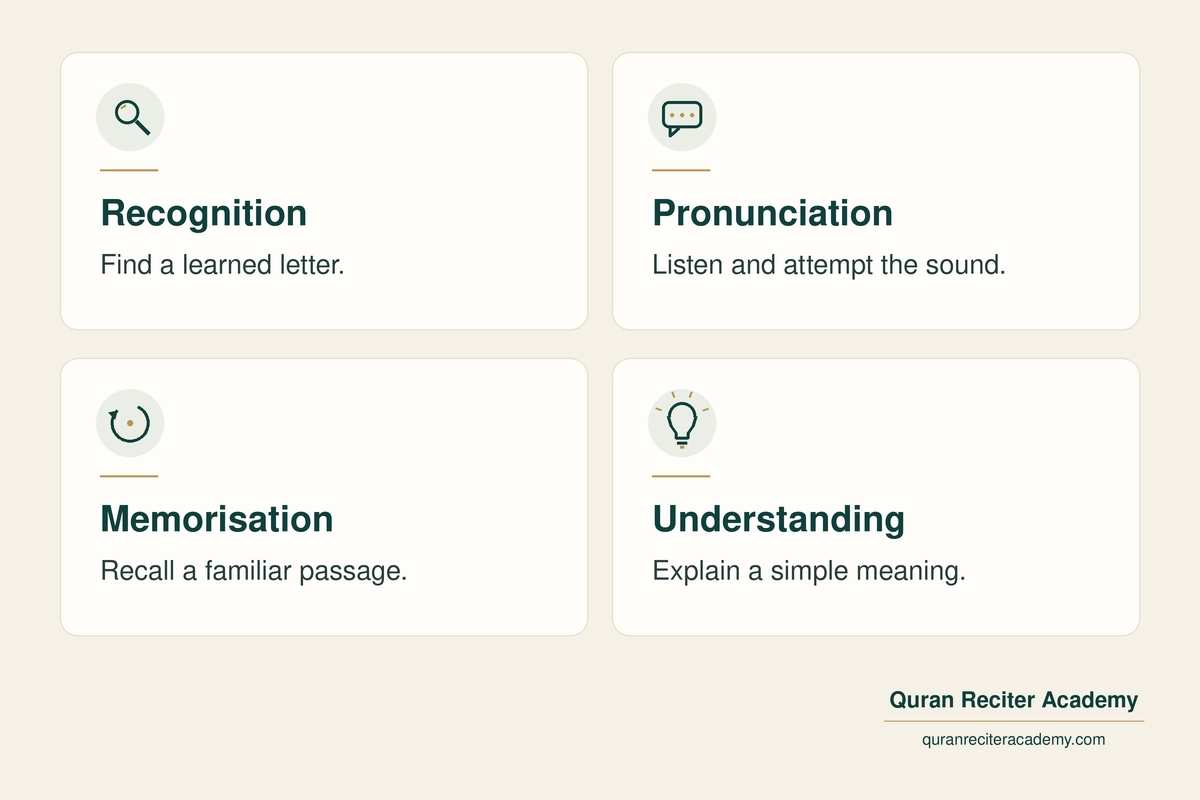
| Learning Goal | What the Child Practises | What the Teacher Checks |
|---|---|---|
| Letter recognition | Finding a learned letter in a small selection | Whether the child recognises it without a hint |
| Pronunciation | Listening to a sound and attempting it | What needs correcting and how to explain it |
| Early reading | Joining familiar letters and vowel sounds | Whether the child reads a new combination |
| Memorisation | Recalling a short, suitable passage | Accuracy and retention of earlier learning |
Understanding is another goal. A teacher can introduce a brief explanation in language the child understands, without expecting reading, memorisation and understanding to develop at exactly the same pace.
For example, remembering a short surah from listening is a useful achievement. The teacher should separately check whether your child can read its printed words.
Where Noorani Qaida Fits
Noorani Qaida is a beginner reading resource used to introduce Arabic letters, vowel marks and combinations. Ask how the teacher selects exercises and checks understanding before moving forward.
If your child needs these foundations, ask about the Noorani Qaida course for kids and how its lessons would match their starting level.
Pronunciation matters from the beginning. Tajweed, the rules governing correct Quran recitation, can be introduced through modelling and guided practice, with terminology explained as it becomes useful.
Make the Activity Interesting and the Goal Clear
A playful activity should give the teacher a way to observe learning. Colourful slides, rewards or games are most useful when they connect to the skill being practised.
NAEYC’s early-learning principles describe a place for guided play alongside direct teaching. Applying that idea here means choosing an engaging activity with a clear learning purpose. It does not establish a particular Quran curriculum or completion time.
A Letter Hunt With a Learning Goal
The following is an illustrative activity to discuss with the teacher:
- Choose the material. Use two or three teacher-approved letter cards, including a letter your child has already encountered.
- Invite a search. Ask your child to find the selected letter on a clean table.
- Check recognition. Notice whether they identify the letter or follow a pointing gesture.
- Practise the sound. The teacher models its sound and gives the child a chance to attempt it.
- Check again later. Change the cards’ positions and revisit the letter after another activity.
If the child guesses repeatedly, reduce the choices and demonstrate again. If they recognise the letter comfortably, the teacher can add a suitable challenge.
The purpose is recognition and sound practice. Avoid turning the task into a speed competition.
Keep Corrections Small and Understandable
When a sound needs work, the teacher can model it again and explain one adjustment. Listen for feedback that helps the child try something specific.
An illustrative response might be: “Listen once more, then we’ll try it together.” The exact correction should match the pronunciation issue.
In Sahih al-Bukhari 69, the Prophet ﷺ instructed people to facilitate religious matters and give encouragement rather than repel others. This offers a relevant reminder about the spirit in which a child is introduced to learning.
Kindness and accurate teaching can work together. Ask how the teacher maintains both when a child struggles.
Plan a Short Session Before Adding More
When planning Quran classes for 5 year old kids, discuss the length of the learning activities as well as the total booked lesson.
A session might include a greeting, familiar revision, a small new task and a recap. The teacher should explain how they adjust these parts when a child needs a pause.
The following 12-minute example illustrates how a short introduction could be organised. It is a planning suggestion, not a universal attention-span rule or a required lesson duration.
| Suggested Time | Activity |
|---|---|
| 3 minutes | Greeting and review of a familiar item |
| 4 minutes | One small new task with teacher modelling |
| 3 minutes | Another attempt, with a brief movement pause if needed |
| 2 minutes | Recap and one home-practice instruction |
The balance can change. Some children may need a slower introduction; others may comfortably engage for longer.
Choose a Weekly Arrangement Your Family Can Maintain
Tell the provider about school or nursery hours, travel and other commitments. Ask how taught lessons and brief home reviews would fit around them.
Avoid accepting a timetable based only on how quickly a course is supposed to finish. Agree how the teacher will review the schedule after seeing your child participate.
A manageable arrangement should leave room for sleep, play and family life, while giving the child opportunities to revisit learning.
Compare Class Formats by Participation and Feedback
Different formats can work, depending on the child and the teaching arrangement.
Individual lessons: Ask whether the teacher adjusts activities to your child’s answers and explains a personal practice task afterwards.
Small group classes: Check group size, learning levels and the amount of time each child gets to respond. A child should have opportunities to practise while the teacher listens.
Local classes: Observe the environment, supervision and how parents receive information about learning.
The children’s Quran course information can help you identify which arrangements to ask the academy about.
Online Quran Classes for Kids
Online Quran classes for 5 year old kids need clear sound, a visible learning resource and an adult who can help with the device.
During an introductory session, check whether the teacher can hear the child’s attempts accurately. Notice whether the child is actively answering, pointing or practising throughout the activity.
Keep the device in a shared space and manage lesson messages through a parent’s account. Ask about recording consent, access to recordings and how concerns are reported.
UNICEF’s online-safety guidance recommends discussing communication, protecting personal information and spending time with children online. These principles are useful when setting up supervised tuition.
Questions to Ask Before Enrolling
Ask the provider:
- What experience does the teacher have with young beginners?
- How is the teacher’s Quran recitation assessed?
- Can instructions be explained in a language my child understands?
- What happens if my child needs a shorter task or a parent nearby?
- How will you communicate progress and practice instructions?
- What are the fees, cancellation terms and arrangements for missed lessons?
Observe a session alongside the answers. A description of patient teaching is more meaningful when you can see how it works.
Keep Home Practice Small and Supportive
The home routine should support Quran classes for 5 year old kids with a task that the teacher has explained clearly.
Ask for one exercise, the expected practice method and a reliable pronunciation model if needed. A brief review of a familiar item can be enough to begin with.
You might offer a simple choice: “Shall we listen first or look at your lesson?” Keep both options connected to the agreed task.
If you cannot read Arabic, you can still help by opening the correct resource, playing an approved recording and noting questions. Leave uncertain pronunciation corrections for the teacher.
When Your Child Does Not Want to Practise
Look for a specific difficulty. Your child may be tired, unsure what to do or worried about repeating a mistake.
Try one adjustment: move practice earlier, reduce the task or start with something familiar. Tell the teacher what happened so the next lesson can respond to it.
Avoid using shame or comparing your child’s progress with another child’s. If distress continues, review the task, teacher interaction and timetable together.
Review Progress Through Small, Observable Changes
Review Quran classes for 5 year old kids by looking at what your child can now do with less help.
Useful examples include:
- Finding a learned letter when its position changes.
- Remembering an earlier sound after a break.
- Attempting a familiar item without waiting for the answer.
- Applying a correction the teacher has demonstrated.
- Asking for help when something is unclear.
Ask the teacher to separate independent success from success after prompting. Both can inform the next lesson, but they show different levels of support.
A simple parent update can cover three points: what was learned, what still needed help and what to practise next. Progress should guide the next activity rather than create a race through pages.
Questions Parents Often Ask
Does My Child Need to Read English Before Starting?
No. Reading English is not a prerequisite for beginning Arabic letter recognition and sound practice. The teacher does need a way to communicate instructions your child understands, using suitable language, demonstrations and visual support.
Can My Child Learn Quran Without Knowing Spoken Arabic?
Yes. Beginning to read Arabic script is a different goal from learning to speak Arabic. Ask how the teacher will explain tasks in a familiar language and introduce simple meanings alongside recitation.
Does My Child Need to Write Arabic During Lessons?
Ask whether the class focuses on reading, recitation or handwriting. Recognising and pronouncing letters can be practised without long writing exercises. If writing is included, the teacher should explain its purpose and adapt the task to what your child can comfortably manage.
Ask for a Starting Plan That Fits Your Child
If you are exploring Quran classes for 5 year old kids, prepare a short description of your child’s current learning, preferred language and available times.
You can ask Quran Reciter Academy about a beginner learning plan and enquire about an initial assessment, suitable class arrangements and fees.
A useful first plan should identify one starting goal, explain how lessons will be supported and show how progress will be reviewed. Choose the next step your child and family can manage comfortably.