It is 8:00 PM after a long, exhausting Tuesday, and as you sit down for a quick evening Qaida lesson, you notice your child confusing Fathah and Kasrah for the third time tonight. They have just spent seven hours immersed in English phonics at their public school, and now, transitioning their brain to Arabic vowels feels like a frustrating, uphill battle for both of you.
You desperately want them to love reading the Quran, but the stress of constantly correcting the same basic symbols is slowly building up at the kitchen table. This is a completely normal developmental phase in early Arabic literacy, and you are not failing as a parent.
In this practical troubleshooting guide, you will learn exactly why these mix-ups happen, the hidden signs of reading fatigue, and how to correct these mistakes at home without shedding tears. For families needing structured support, Quran Reciter Academy connects parents with certified tutors who patiently guide Western-raised children through these exact foundational reading milestones.
The Spiritual Weight of Early Reading Struggles
عائشة رضي الله عنها قالت: قال رسول الله صلى الله عليه وسلم: “الماهر بالقرآن مع السفرة الكرام البررة، والذي يقرأ القرآن ويتتعتع فيه وهو عليه شاق له أجران”
‘Aishah (May Allah be pleased with her) reported: The Messenger of Allah (ﷺ) said, “The one who is proficient in the recitation of the Qur’an will be with the honourable and obedient scribes (angels) and he who recites the Qur’an and finds it difficult to recite, doing his best to recite it in the best way possible, will have a double reward.”
(Sahih Al-Bukhari and Muslim)
When you live in North America, Europe, or Australia, carving out dedicated time for Arabic reading between soccer practice and public school homework feels monumental. It is incredibly easy to view these evening study sessions as just another academic chore that needs to be checked off your daily list. However, this beautiful Hadith reframes your child’s struggle from a point of deep frustration into a profound source of immense spiritual blessing.
The stammering and the intense difficulty your child faces while learning these basic symbols are not signs of academic failure. They are directly earning them, and you as their guide, a double reward from Allah. Teaching them the Book of Allah is one of the most powerful acts of worship you can fulfill as a Muslim parent today.
You are doing the vital, sacred work of preserving their Islamic identity in a society that constantly pulls them in the opposite direction. Every time you gently correct a misplaced vowel, your patience during these difficult lessons is an act of deep devotion.
Why is a child confusing Fathah and Kasrah so frequently?
Understanding the root cause of an error is the first step toward finding a lasting solution. When a child looks at an Arabic letter, their brain has to process the shape, the dots, and the tiny vowel mark all at the exact same time. This is a massive cognitive load for a young learner who is still mastering their primary spoken language.
According to a 2022 study in the Journal of Early Childhood Literacy, young children often struggle with directional symbols because their spatial awareness takes several years to fully develop. To them, a diagonal line above a letter and a diagonal line below a letter look identical when skimming a page.
Little Yusuf sat at the kitchen island, swinging his legs as he pointed to the Arabic letter Baa. His mother, Amina, watched patiently as he confidently called the bottom mark a Fathah, clearly guessing instead of reading. Once she covered the letter itself with her thumb and only showed the tiny diagonal stroke, his face lit up with understanding. He finally realized he needed to look at the surrounding clues, not just the familiar letter shape.
A 2023 Pew Research report highlights that passing down religious identity is the top parenting priority for Muslim Americans, making early Arabic literacy a critical milestone. This urgency often makes parents rush the foundational steps. When we rush, children rely on memory instead of visual recognition, leading to constant symbol confusion.
Common Qaida reading mistakes to watch for during practice
As a parent, you need to know exactly what to look for when monitoring your child’s reading progress. Often, a child confusing Fathah and Kasrah is just one symptom of a larger phonetic misunderstanding. If you can identify these specific habits early, you can correct them before they become permanent issues.
Here are the most common signs that your child is struggling with foundational rules:
- Your child might constantly stretch the short vowel sound into a long one, turning a quick “ba” into a drawn-out “baa.”
- They frequently guess the vowel sound based on the shape of the letter rather than looking at the tiny mark itself.
- You notice them trying to apply English silent letter rules to their Arabic reading practice when encountering unfamiliar words.
- They easily recite the alphabet from memory but freeze up entirely when the symbols are randomized on the page.
- Your child looks directly at the bottom mark but automatically pronounces the top mark out of pure habit.
- They become visibly frustrated and try to rush through the page without actually looking at the printed words.
- You hear a heavy breath or an echoing sound at the end of their vowels instead of a crisp, sharp stop.
Comparing English phonics and basic Arabic vowels
A major reason for reading confusion is the structural difference between English and Arabic. Your child spends all day learning that vowels are distinct letters like ‘A’ or ‘E’ that sit right next to consonants. In Arabic, the vowels are tiny accents floating around the letters.
Differences Between English Phonics and Arabic Harakat
| Linguistic Feature | English Phonics System | Arabic Harakat System |
| Vowel Placement | Usually written directly in line with consonants. | Placed dynamically above or below the letters. |
| Sound Duration | Can easily be stretched, blended, or completely silent. | Extremely short, crisp, and never silent on their own. |
| Reading Consistency | Changes drastically based on the word structure. | Always makes the exact same sound regardless of the word. |
| Visual Indicators | Uses distinct, large alphabet letters (a, e, i, o, u). | Uses small strokes, tiny loops, and resting circles. |
| Directionality | Read completely from left to right across the page. | Read consistently from right to left across the page. |
When you actively acknowledge these differences, you help your child separate their “school brain” from their “Quran brain.” This mental separation is crucial for mastering new symbols.
A step-by-step method to teach Harakat at home effectively
Correcting vowel confusion requires a structured approach that removes the pressure of reading full sentences. You have to strip the lesson back down to the absolute basics to rebuild their visual confidence.
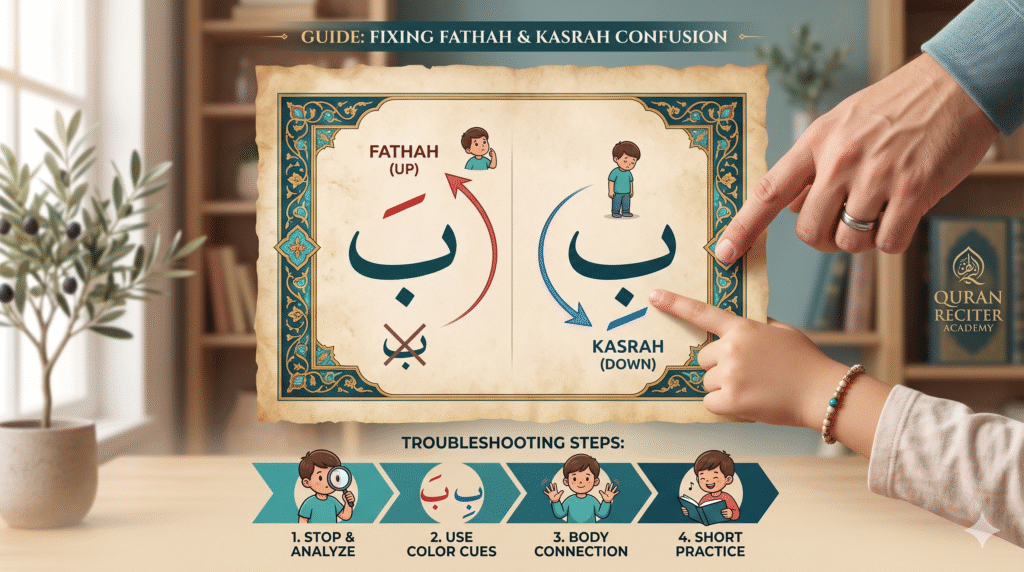
- Isolate the symbols completely. Do not try to teach the top and bottom strokes on the same day. Spend an entire week just focusing on the top mark before formally introducing the bottom one.
- Use physical hand gestures. Have your child point up to the ceiling when they see the top mark, and point down to the floor for the bottom mark. This physical movement builds instant, powerful muscle memory.
- Create color-coded visual aids. Use a red highlighter for the top stroke and a blue highlighter for the bottom stroke in their daily practice book. This immediately helps their brain separate the two similar symbols.
- Practice with a tapping rhythm. Tap a pencil on the desk once for each letter to enforce a quick, bouncy sound. This physical boundary stops them from stretching out the vowels into long, incorrect sounds.
- Praise the effort, not just accuracy. Openly acknowledge how hard they are working to learn a completely new language system. A positive, encouraging environment keeps them highly motivated to open the book again tomorrow.
Fixing Quran pronunciation for kids using visual cues
Children are highly visual learners, and sometimes verbal corrections simply go in one ear and out the other. If you find yourself repeating the same correction ten times a minute, you need to change your teaching medium. Research in bilingual education shows that multi-sensory learning—using hands, eyes, and voice simultaneously—can increase reading retention in young learners by over 40 percent.
By engaging multiple senses, you bypass the cognitive fatigue that happens when a child just stares at a black-and-white page. Try drawing the letters in a tray of sand, or using playdough to physically build the vowel marks above and below the letters.
Quick tip for parents: Whenever your child gets stuck on a symbol, resist the sudden urge to immediately tell them the answer. Instead, ask them, “Is the tiny mark sitting on the roof or hiding in the basement?” This simple, visual question forces them to analyze the placement independently and builds long-term reading confidence.
Remember to keep your sessions incredibly brief. Ten minutes of highly focused, positive practice is far better than an hour of frustrating, tear-filled reading. Consistency will always beat intensity when it comes to early childhood education.
Frequently Asked Questions
How long does it take for a child to master these vowels?
Every child learns at their own unique pace, but most children take about three to six weeks of consistent daily practice to confidently differentiate the symbols. Rushing this specific phase usually leads to severe reading fluency issues later on. Short, ten-minute sessions every single day yield the best long-term results.
Why does my child mix up symbols only when reading full words?
When reading isolated letters, your child only has to focus on one single task. Reading full words forces their brain to connect letters, remember pronunciation rules, and plan the next sound simultaneously. This cognitive overload causes them to default to guessing, which is why they suddenly forget the basic vowel shapes.
Should we stop memorizing until these reading mistakes are fixed?
You do not have to completely halt their memorization, as listening and repeating is a different skill than visual reading. However, you should heavily prioritize fixing their reading foundation before pushing them to read new surahs from the text. A broken reading foundation makes independent memorization nearly impossible in the future.
What is the absolute best age to introduce Arabic vowel rules?
Many educators recommend introducing basic Arabic letters and vowels between the ages of four and six, when a child’s brain is highly receptive to new languages. However, older children can easily grasp these rules if the instruction is logical and patient. The best age is simply whenever your child is ready to sit and focus for short periods.
How can I keep my child from getting upset during lessons?
Always start the lesson by praising something they did perfectly the day before to set a positive tone. If you notice them getting flustered, immediately stop the reading and switch to a fun, physical game like pointing out symbols on the page. Never force them to continue reading through tears, as this creates a negative association with the Quran.
To wrap up
In summary, seeing a child confusing Fathah and Kasrah is a normal hurdle that requires immense patience and a shift in teaching tactics. You can fix this by completely isolating the symbols, incorporating physical hand gestures, and keeping your daily practice sessions short and positive. Remember to acknowledge the massive linguistic shift they are making when switching from English to Arabic.
Your quiet dedication to teaching your child proper recitation is planting a beautiful seed for their Islamic future. Every single correction you make is building a lifelong, confident relationship with the Book of Allah. If you feel overwhelmed balancing this with daily life, let the experts help; mention Quran Reciter Academy for the second and final time by booking a free trial Quran class for your child today. May Allah make it easy for you and your family.