
Online Quran Classes for Teenagers A Practical Guide
Online Quran classes for teenagers should begin with an assessment of the learner’s current skills, a goal they understand and a timetable that fits school life. Look for a teacher who explains corrections respectfully, gives specific practice tasks and checks whether earlier learning is being retained.
A teenager may be starting with Arabic letters, returning after a break or improving recitation they already know. Age alone does not identify the right course.
For parents, the first step is to involve your teen in the choice. A useful plan should make clear what they will learn, how they can ask questions and what support they need between lessons.
Start With a Conversation Your Teen Can Help Shape
Before comparing online Quran classes for teenagers, ask your teen what feels comfortable and what they want help with.
Their answer may be practical: they struggle to recognise vowel marks, feel unsure when reading aloud or want to understand a familiar surah. They may also have preferences about the teacher, lesson time or learning alone versus joining a group.
Try questions such as:
- Which part of Quran learning would you most like to improve?
- Is there anything about previous lessons you found difficult?
- Would you prefer an individual lesson or a suitable peer group?
- What practice time could you manage during an ordinary school week?
UNICEF’s guidance on communicating with teenagers recommends asking about their views and listening actively, including when parents and teens disagree. These are useful principles for discussing a learning plan together.
Avoid turning this conversation into a comparison with siblings or classmates. The aim is to identify a starting point your teen can discuss honestly.
If Your Teen Feels Embarrassed About Starting
Ask the provider how it supports older beginners. A teen may prefer individual assessment before joining a group, or materials presented in a way that respects their age.
They can begin with foundational skills without being treated like a much younger learner. Ask how the teacher adapts explanations, examples and feedback.
Quran lessons for teens should leave room for questions about both the learning task and the purpose behind it.
Match the Starting Point to Skills, Not School Age
Ask the teacher to assess reading, pronunciation and any existing memorisation separately. A familiar recitation learned by listening may not show whether the learner can read the same words independently.
| Current Starting Point | Useful Learning Focus | What the Teacher Should Check |
|---|---|---|
| New to Arabic script | Letters, vowel marks and sound combinations | Recognition and independent attempts at suitable combinations |
| Reads with frequent hesitation | Guided reading and targeted practice | Which part of the reading process causes difficulty |
| Reads comfortably but repeats errors | Tajweed applied to selected passages | Whether a correction transfers to a different example |
| Has memorised material but struggles to retain it | Revision alongside suitable new learning | Recall, pronunciation and the amount of prompting needed |
Tajweed concerns the rules governing correct Quran recitation. Reading fluency, pronunciation, memorisation and understanding are related skills, but they need different checks.
For a complete beginner, review the Noorani Qaida course information and ask how foundational lessons would be adapted for a teenager.
If understanding is a priority, ask which translation and explanatory resources the teacher uses. Agree how meaning will be studied alongside the reading or recitation goal.
Quran Memorisation for Teenagers Needs Revision
Hifz means memorisation. Before increasing new material, ask how the teacher checks existing recitation and plans revision.
A useful plan should explain what is reviewed, how older passages remain in the routine and what changes when recall becomes less dependable.
Completing more new lines is only one measure. Retaining earlier material accurately should remain part of the discussion.
What Should Online Quran Classes for Teenagers Look Like?
Look for active participation, clear explanations and feedback the learner can use afterwards.
During an introductory lesson, notice whether the teacher hears your teen’s own attempts, explains a specific correction and allows another try. The learner should understand what they are practising rather than simply repeating an unexplained instruction.
Useful questions for the provider include:
- What experience does the teacher have with teenage beginners or returning learners?
- How is the teacher’s Quran recitation assessed?
- Which language can be used to explain difficult points?
- How are questions handled during lessons?
- What feedback does the learner receive between sessions?
- How can the plan change during a demanding school period?
The academy’s Quran teacher information is a relevant place to begin enquiries about experience and teaching arrangements.
If your family or teen has a teacher-gender preference, state it before booking and confirm availability.
Compare Individual Lessons and Peer Groups
Individual lessons allow the teacher to focus on one learner’s recitation and pace. Ask how the session will be organised and what practice follows it.
A suitable group may provide discussion and shared learning. Check participants’ starting levels, the age range and the amount of individual reading time each learner receives.
Ask whether corrections are given in a way that allows the learner to try again comfortably. A group explanation of a rule should still connect to opportunities to practise.
The best fit depends on the learner and the teaching arrangement. Include your teen’s observations when deciding after an introductory session.
Turn a Recurring Mistake Into a Clear Practice Task
In online Quran classes for teenagers, lesson feedback should lead to an understandable task the learner can practise between sessions.
Tajweed for teenagers should connect the rule being explained to what the student actually recites. If pronunciation is the main need, review the online Tajweed lesson information and ask how individual feedback is provided.
A Worked Example: Reading a Vowel Mark Carefully
This is an illustrative activity for a learner who repeatedly overlooks a vowel mark. The teacher should select and verify the actual Arabic material.
Purpose: help the learner notice the relevant mark and apply its sound accurately.
- Identify the pattern. The teacher listens to a short selection and checks whether the same type of mistake recurs.
- Explain one correction. The teacher points out the mark, models the correct reading and explains what changes.
- Compare suitable examples. Use a small teacher-selected set in which the relevant marks can be compared.
- Attempt a new item. The learner reads another suitable example without hearing the answer first.
- Review after a gap. Return to the skill during later practice and a subsequent lesson.
What to observe: whether the teen notices the mark independently, needs a reminder or still needs the sound modelled.
Useful feedback: identify what improved and the next adjustment. Avoid giving several unrelated corrections at once.
When to change the task: simplify the material if the learner remains confused. Add challenge when they can manage the current task with less help.
A brief note can record the current difficulty, the teacher’s correction and one question for the next lesson. Parents do not need to invent pronunciation explanations themselves.
Make a Normal-Week Plan and an Exam-Week Plan
A workable plan for online Quran classes for teenagers includes what happens when school demands change.
Discuss lessons, homework, activities, travel and rest before committing to a timetable. Ask how much home practice the proposed course expects and whether that is realistic.
General learning guidance from the Institute of Education Sciences supports spacing learning over time and revisiting earlier material. This supports repeated review, but it does not establish a fixed Quran timetable for every teenager.
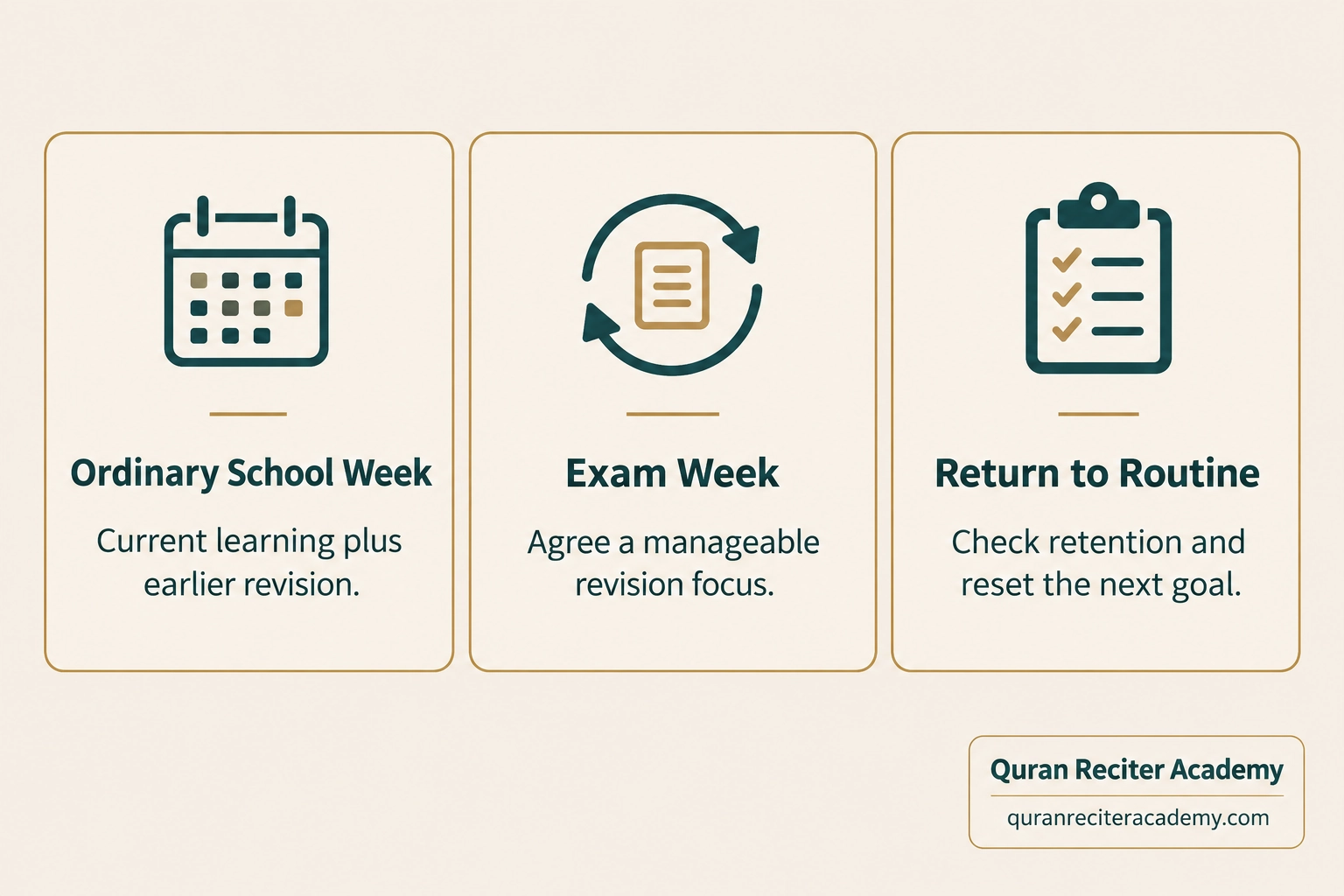
The following is an illustrative planning framework:
| Type of Week | Learning Focus | What to Agree With the Teacher |
|---|---|---|
| Ordinary school week | Current learning plus earlier revision | Regular lesson times and a manageable practice task |
| Busy assessment or exam week | Maintain suitable familiar material | Whether to reduce new assignments or adjust lessons |
| Return to the usual routine | Check retention before increasing work | Which material needs revisiting and what comes next |
Agree any lesson changes in advance, including their effect on fees or attendance. An adapted plan needs clear expectations.
In Sahih al-Bukhari 6465, the Prophet ﷺ praised regular deeds even when few and encouraged undertaking what is within one’s ability. This paraphrases the report and offers a relevant reminder about consistency and manageable commitments.
Give Home Review a Specific Purpose
A review might revisit an earlier passage, practise the current correction and finish with one question to ask the teacher. Discuss a realistic amount of material rather than measuring effort only by minutes.
For memorisation, include older material. For a beginner, focus on the assigned reading task. For meaning, ask the learner to explain a studied point in their own words.
The teacher should clarify what to prioritise when time is limited.
Agree on Parent Involvement and Online Boundaries
For online Quran classes for teenagers, agree how the learner, teacher and parent will communicate.
A teen can take responsibility for preparing materials and attempting assigned work. Parents can help with scheduling, access to resources and questions about the arrangement.
For learners who are minors, ask the provider about its safeguarding procedures and how parents or guardians are involved. Agree on approved communication channels and a clear way to raise concerns.
Ask whether lessons are recorded, who can access recordings and how submitted recitation files are handled. Explain these arrangements to your teen before sharing their work.
Use a Short Learning Agreement
A simple agreement can cover:
- Learner: prepare the assigned resource and bring a question when something is unclear.
- Teacher: explain the current goal and provide specific practice instructions.
- Parent: support attendance and raise practical concerns without taking over every response.
- Review: discuss what is working and whether the task or timetable needs adjusting.
Agree which progress updates parents receive and how the teen participates in those conversations. The arrangement should support learning while allowing the learner to develop responsibility.

Review Progress Before Making a Long Commitment
Ask what your teen can now do with less help. Useful signs might include reading a new example correctly, applying an earlier correction or recalling a passage after a gap.
Compare these observations with the original goal. Attendance and completed pages give useful information, but they do not describe every learning outcome.
Before paying for a longer programme, check lesson duration, class size, feedback arrangements, missed-lesson terms, additional resource costs and cancellation conditions.
If Your Teen Starts Avoiding Lessons
Ask what has changed. The task may feel unclear, the pace may be unsuitable or the timetable may conflict with schoolwork.
Let your teen describe the difficulty, then discuss one adjustment with the teacher. That could mean a clearer practice task, a different lesson time or a review of the starting level.
Avoid treating reluctance as proof of laziness or lack of interest in the Quran. Identify the practical issue before deciding what should happen next.
Questions Parents Often Ask
Can Lessons Include Meaning Alongside Recitation?
They can, depending on the teacher and course. Ask which translation and explanatory resources are used and how lesson time is divided. Keep goals clear: accurate recitation and explaining a studied meaning require different forms of feedback.
What Equipment Does My Teen Need?
Ask which learning platform and resources the provider uses. Test the supported device, microphone, sound and internet connection before the first lesson. The learner should be able to see the assigned material clearly and hear pronunciation models without interruptions.
Can My Teen Change Teachers if the Arrangement Is Unsuitable?
Check the provider’s policy before enrolling. Ask whether a change is possible, whether it involves a fee and how learning notes are transferred. Explain the specific concern so that any proposed change addresses the difficulty.
Choose a Starting Plan Together
Before choosing online Quran classes for teenagers, agree on the learner’s current starting point, one main goal and the times your family can maintain.
You can ask Quran Reciter Academy about a suitable teenage learning plan and enquire about assessment, teacher options, class format and fees.
A useful first plan should explain what will be practised, how feedback will be given and when progress will be reviewed. Include your teen in that conversation so the next step is clear to everyone.