Online Quran Classes for Seniors A Comfortable Way to Begin
Online Quran classes for seniors can offer a practical way to learn from home, provided the teaching suits your reading level, preferred pace and comfort with technology. You may need help recognising Arabic letters, correcting familiar recitation or returning to lessons after many years. The right starting point depends on what you can do today.
Begin with a simple assessment rather than choosing a course by its name. Ask the teacher to listen, explain what needs attention and suggest a manageable first goal. A clear explanation and respectful correction matter more than a promise to finish quickly.
You do not need to become confident before asking for help. Lessons should give you room to ask questions, repeat a difficult sound and build confidence through practice.
Choose Your Starting Point Before Your Course
Being an older learner does not automatically make you a beginner. You might read Arabic comfortably but need pronunciation support. You might remember several surahs without being able to read unfamiliar passages independently.
Reading, memorisation and understanding are different skills. A useful assessment checks them separately.
| Your Current Situation | A Suitable First Focus | What the Teacher Should Check |
|---|---|---|
| You cannot recognise Arabic letters reliably | Letter recognition and basic sounds | Which letters and vowel marks you recognise |
| You recognise letters but struggle to join them | Guided word reading | How you connect letters and follow vowel marks |
| You can read but hesitate or make recurring errors | Reading practice and pronunciation | Where you pause, guess or repeat mistakes |
| You recite comfortably and want refinement | Applied Tajweed | Specific pronunciation and recitation rules |
| You mainly want to understand what you recite | Translation and explanation | Your language preference and understanding goals |
If the alphabet is your starting point, explore the proposed Noorani Qaida lessons for beginners. Noorani Qaida is a beginner reading text that introduces Arabic letters, vowel marks and combinations.
If you already recognise letters, ask whether a full beginner course is necessary. A focused review may be more appropriate than restarting everything.
What to Look for in Online Quran Classes for Seniors
When comparing online quran classes for seniors, ask how the teacher would adapt a lesson to you. A course description saying “all ages welcome” does not explain how correction, practice or technical support will work.
Respectful, Specific Correction
Useful feedback identifies one issue and shows you what to change.
For example, a teacher might say: “Listen to this sound once. Now repeat it slowly, then try it in the word.” That gives you a clear action.
Repeatedly hearing “wrong” or being asked to restart an entire passage without explanation gives you less help. You should be able to ask for another demonstration without feeling that you are delaying the lesson.
A Pace That Matches Your Learning
Some older adults prefer a steady, detailed explanation; others want a brisk lesson with challenging practice. Age alone should not decide the pace.
Ask the teacher to adjust according to your reading, concentration and feedback. If you understand a point quickly, move forward. If you need more practice, spend time on it.
Clear Communication in Your Preferred Language
Knowing how to recite and knowing how to explain a correction are separate requirements.
Ask which language the teacher uses for explanations. If you understand Urdu more comfortably than English, for example, check that this can be accommodated before committing.
Likewise, mention any preference for a male or female teacher and ask what is available.
Make the Lesson Comfortable to See and Hear
You do not need to report a difficulty unless it affects your learning, but explaining practical preferences can help the teacher prepare.
If Small Text Is Difficult to Read
Try a larger screen or a clearly printed copy of the lesson material. Ask the teacher to display one relevant line rather than a whole page of small text.
Check that you can see vowel marks clearly, since enlarging the letters without making the marks readable may leave the main difficulty unresolved.
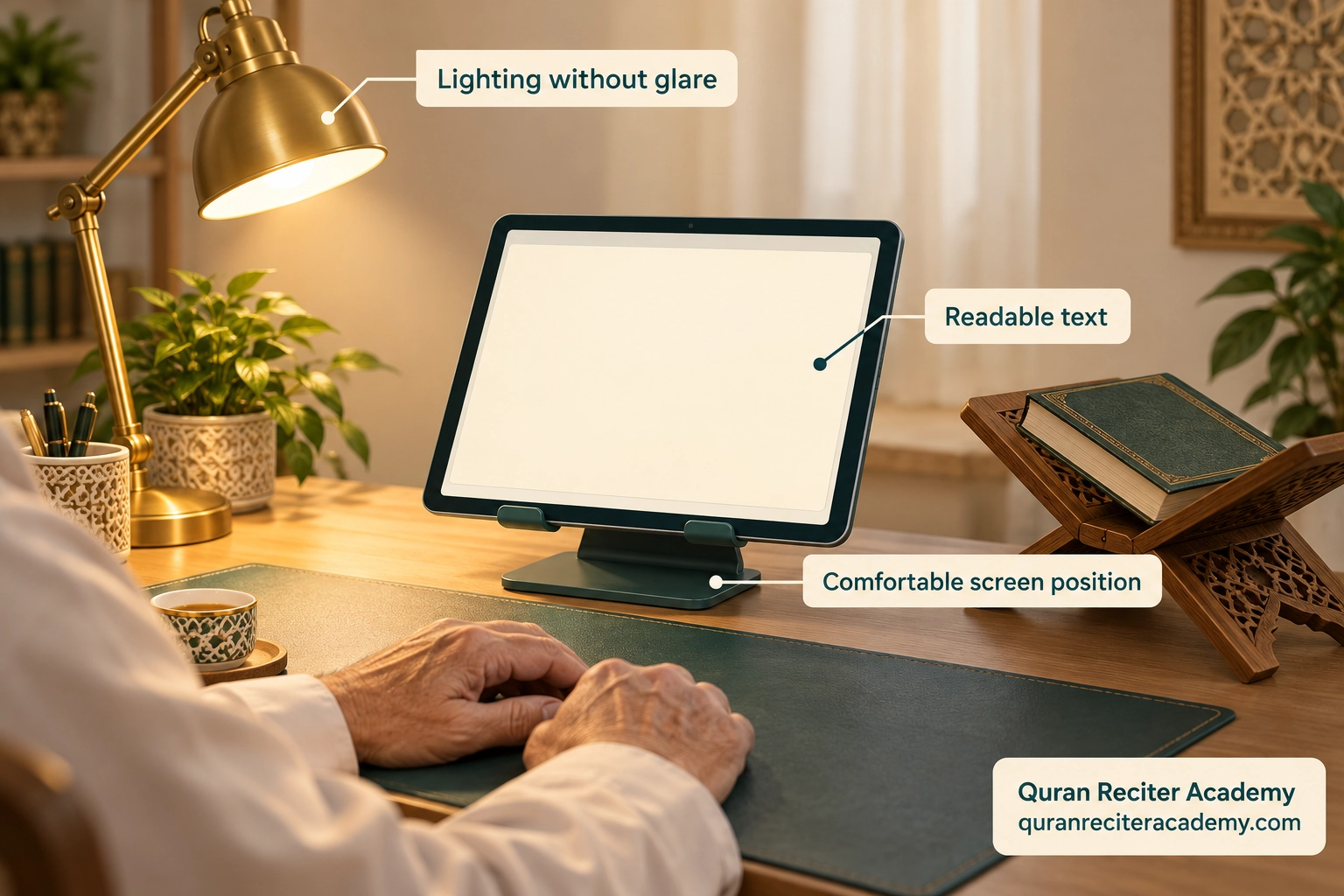
Use comfortable lighting and position the screen to avoid glare. Choose a setup you can maintain without leaning forward throughout the lesson.
If Audio Is Unclear
Before accepting a pronunciation correction, make sure you heard the model clearly.
Ask the teacher to repeat the sound if the connection breaks or the microphone distorts it. Headphones may help some learners, while others prefer speakers; test what works for you.
When audio repeatedly cuts out, pause the pronunciation exercise and resolve the connection problem. Guessing what the teacher said makes feedback less useful.
If You Prefer Shorter Sessions
A short lesson with a clear purpose may suit you better than a longer session with several new topics.
Discuss lesson duration, breaks and the best time of day for you. For example, you may prefer studying after breakfast rather than late in the evening.
These are preferences to discuss, not limitations that should be assumed about every senior learner.
Use the First Lesson to Test the Teaching
The first meeting should help both you and the teacher understand what comes next. It should also let you experience the teaching style.
Ask for a small activity that matches your level:
- Read a few letters, words or a short passage.
- Let the teacher identify one point to practise.
- Listen to a clear demonstration.
- Repeat the sound or passage with feedback.
- Try it again after a brief pause.
Notice whether the correction becomes clearer to you. You do not have to master it immediately, but you should understand what you are practising.
Before finishing, ask:
- What should I practise before the next lesson?
- How will I know whether I am doing it correctly?
- What will we review next time?
- What happens if I find the practice too difficult?
If you already read connected words, the proposed Quran reading course is a relevant page to explore when discussing your next step.
Build a Routine You Can Repeat Comfortably
A useful starting plan for online quran classes for seniors combines guided teaching with a small amount of independent practice. The schedule should fit your responsibilities and energy, rather than becoming another source of pressure.
The following is an illustrative routine, not a required timetable or a promise of results.
| Part of the Week | Suggested Activity | Purpose |
|---|---|---|
| First lesson | Review familiar material and practise one correction | Establish a clear focus |
| Between lessons | Practise the assigned sound, word or short passage for 5–10 minutes | Repeat a manageable task |
| Next lesson | Attempt the material before hearing another demonstration | Check what you can do independently |
| End of the week | Revisit familiar material and discuss difficulties | Adjust the following week’s work |
Keep the practice task specific. “Read more” is difficult to act on. “Practise these three words slowly and bring back the one you find hardest” gives you a clearer purpose.
If you miss a day, return to the last comfortable task. There is no need to double the workload automatically.

Keep Memorisation Separate From Reading Practice
If you want to memorise a short surah, discuss how it will be revised as well as learned.
Being able to repeat a passage immediately after a teacher is different from recalling it later without prompting. Ask the teacher to check both.
You can also work on reading without taking on a memorisation target. Choose the goal that matters to you.
Keep the Technology Simple From the Beginning
The technology for online quran classes for seniors should be tested before the main teaching begins. Ask which application is used and whether your existing device is suitable.
A phone may be convenient, but a tablet or laptop may make shared text easier to see. Test the actual material before deciding.
Before the first lesson:
- Open the meeting link and check that it works.
- Test the microphone and speaker volume.
- Make sure the device has power.
- Place the lesson material within easy reach.
- Ask what to do if the call disconnects.
A family member can help with the first connection if you want support. Ask them to write down a few clear steps so you can repeat the process yourself.
Agree separately whether they should remain nearby during lessons. Some learners appreciate help; others prefer privacy and independence.
Recognise Progress Beyond Finishing Pages
Progress in online quran classes for seniors should be judged against your own starting point.
Finishing a page is useful only if it reflects learning. You might move slowly through a short passage while becoming more accurate and less dependent on prompts.
Look for practical changes:
- You recognise a letter you previously confused.
- You read a familiar word without guessing.
- You notice and correct a recurring mistake.
- You remember the previous lesson’s correction.
- You can explain what you need to practise next.
Ask the teacher to revisit earlier material occasionally. This helps distinguish something you have retained from something you can repeat only during the lesson.
For learners ready to refine recitation, the proposed online Tajweed lessons are a relevant next area to discuss. Tajweed concerns the rules of Quran recitation, including how letters are pronounced. Its application should be practised through listening, reciting and receiving correction.
Feeling Embarrassed About Mistakes?
Starting again can feel uncomfortable, particularly when younger relatives recite more confidently. Your lesson should give you space to learn without that comparison.
In Sahih Muslim 798a, the Prophet ﷺ describes reward for the person who recites the Quran while faltering and finding it difficult. The narration offers encouragement to a learner experiencing difficulty; it does not set a deadline for becoming fluent.
Tell the teacher if you feel anxious about being interrupted or reading aloud. You can agree on a correction method: for example, immediate feedback during a short pronunciation exercise, followed by comments after a longer reading attempt.
The aim is to make correction understandable and manageable.
Questions to Ask Before Committing
Clarify the arrangements alongside the teaching approach:
- Is the lesson individual or shared?
- What lesson durations and times are available?
- Can the teacher explain corrections in my preferred language?
- What materials and device will I need?
- How are missed lessons and connection problems handled?
- What are the fees and cancellation terms?
- Is an assessment or trial available, and what are its terms?
Do not assume these details from a general course title. Ask for an explanation of the actual arrangement you would receive.
If you are considering online quran classes for seniors, contact Quran Reciter Academy with your current reading level, preferred language and suitable lesson times. Ask which teaching arrangement can meet those needs before choosing a course.
Frequently Asked Questions
Can I Join if I Cannot Read Arabic at All?
Yes, beginner tuition can start with recognising Arabic letters and vowel marks. Ask for an assessment so the teacher can identify what you already recognise and choose an appropriate starting point.
Do I Need to Understand Arabic Before Learning to Recite?
You can begin learning to read and pronounce Quranic Arabic without already understanding the language. Reading and understanding are separate goals, so discuss whether you want translation or explanation included alongside recitation.
Can My Spouse and I Learn Together?
Ask whether shared lessons are available. They may suit you if your levels and goals are similar. If one person needs alphabet work and the other needs advanced correction, separate teaching may give each learner more relevant practice.
Should I Use Transliteration to Start?
Transliteration can help you follow a familiar passage, but it cannot represent every Arabic sound precisely. If independent Quran reading is your goal, ask the teacher to help you move towards recognising and reading Arabic script.
Can I Record Lessons for Revision?
Ask the teacher and academy before recording, and obtain agreement from everyone involved. Also check whether recordings are permitted, how they may be stored and whether they are for your personal revision only.